Wednesday, February 3, 2016

Avraham Avinu: The First Jew

     On Monday we spent our class talking Avraham Avinu (Abraham our father). We began by talking about his call from Hashem (Genesis 12) and whether or not we thought it was a literal call or more of a gut feeling or inspiration. The students offered a number of interesting suggestions for what kind of man they thought Abraham must have been, which I hope they'll share in the comments.
     Moving forward in Avraham's life we see that he travels along derekh hahar (the mountain road) to arrive at Shechem (near modern day Nablus in the West Bank). Whereas most of the modern Israeli population is located on the coastal plain, traditionally it's the mountainous interior where most Jews lived. This is an important fact to keep in mind when we talk about giving up land for peace. The Tanakh tells us that Avraham avinu, the founder of our people, lived in the area that, if there's a two state solution, will one day be a part of Palestine.
     He then continues down into Egypt where he curiously refers to his wife Sarah as his "sister". After giving the students a chance to think of reasons why he might do this I told them about the Nuzi documents, documents found in modern day Iraq that mention a legal principle in which the sister-wife is the most important wife. But if we accept that explanation then there are other incongruities in the story (and my understanding is that the most recent evidence suggests that sister-wife explanation is likely flawed). For example, if this was a well-known status, why were the Egyptians angry when they found out about it? Understanding the Tanakh is rarely simple. Solving one problem often creates another.
     We then talked about one of Avraham's most well-known brits (covenants), his circumcision. As with every covenant there are two sides; Avraham promises to walk in Hashem's ways and God promises to give Avraham the land of Canaan and make him the father of a great nation. The physical sign (another requirement for a brit) for this brit is circumcision (brit milah in Hebrew).
     Perhaps more interesting than the brit milah itself is what happens afterward. Avraham is sitting in his tent, talking to Hashem when three strangers walk up. Avraham immediately rises to greet them (after just getting circumcised as an old man no less!), completely ignoring Hashem. In these few short verses we learn a number of things (and see how the Tanakh is simultaneously an incredible piece of literature and an instruction manual for how to live your life). First, we see Avraham ignore Hashem (who is in the middle of bikur holim, visiting the sick) for the sake of three strangers. In Judaism we divide the 613 mitzvot (commandments) in a number of ways: do/don't do, understand (don't murder) and can't understand (keeping kosher), etc. In Avraham's behavior we see one of the most important divisions, the difference between mitzvot ben adam l'makom (commandments that deal with the relationship between humans and god) and mitzvot ben adam l'chavero (commandments that deal with the relationship between humans). Unlike other religions of the time (and perhaps even of our own time) in Judaism the interactions between people are more important than those between people and Hashem. As I'm sure many of you are aware on Yom Kippur Jews are expected to apologize to the person we wronged, not ask forgiveness from Hashem.
Another interesting mitzva we see demonstrated here is "welcoming the strangers." Even today in desert cultures the idea of hospitality is incredibly important. Given the difficulty of traveling in the desert--little food, even less water--hospitality may well save your life. So while Avraham is making the effort toward his guests in this case, he may well be the needy one next time. Not only is "welcoming the guest" a lovely value, it's a clear reminder of the fact that Am Yisrael began in a desert landscape as nomads.
     Having learned a bit about what kind of man the founder of Am Yisrael is we arrived to what, in my opinion, is the most challenging aspect of the Avraham story. Hashem tells Avraham he's going to destroy Sodom and Gemorrah. Avraham, unhappy with this decision, argues with Hashem, questioning whether Hashem will destroy the righteous together with the wicked. Avraham negotiates with Hashem over how many righteous people need to be present to make the towns worth saving, starting with 50 and eventually talking Hashem down to ten. What chutzpah! A few verses later Hashem commands Avraham to sacrifice his only son, Yitzchak, and Avraham doesn't make a peep. For me, this is a difficult series of events to try and understand. We know that Avraham is willing to argue with Hashem, but doesn't try to save his only son. Is Avraham willing to argue for the public good, but not for his personal happiness? Is God testing Avraham? If so, what's the test? Is it, as tradition teaches, a test of Avraham's faith? Is it a test to see whether Avraham understands that Judaism is a truly different religion that doesn't demand human sacrifice? Is Avraham testing God? How do you think this episode affects Avraham's relationship with God? His relationship with Yitzchak? How do you think this event affects Yitzchak? I look forward to hearing all your suggestions in the comments. 

Tel Gezer: Who were the Canaanites?

      While it's great to discuss something in class, one of the amazing aspects of NFTY EIE is visiting sites and trying to understand things for ourselves. To try and further understand the development of civilization in the ancient Near East we went on our first tiyul (field trip), In class we had briefly mentioned Avraham Avinu (Abraham Our Father, the first Jew). The first thing we see with Avraham is that Hashem tells him "Lech Lcha" instructing him to pick up, leave his home in Mesopotamia, and go to Canaan (also the inspiration for an excellent Debbie Friedman song). We looked at the route he took and the places he visited, and saw that, given the population and movement patterns in this region it seems like quite a reasonable story (at least in that particular aspect).  Having established that Avraham was coming to Canaan we set out to explore Gezer and try to understand the Canaanites who dwelt there.
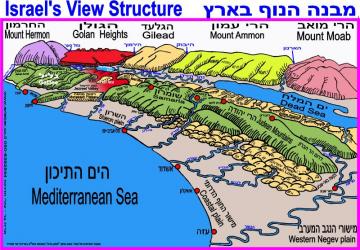
     The first place we stopped was an overview, from which we could see the entire surrounding area. This lookout was an excellent place to see the main geographic features of Israel. Next to the Mediterranean Sea is the coastal plain, where the majority of Israel's population resides today (though not in the past). Moving east the land slowly starts to rise into the the Shfeyla (foothills). As you continue toward Jerusalem (east) the land continues to rise into the Judean Mountains before falling abruptly into the Jordan Valley (which includes features such as the Kinerret, Jordan River and Dead Sea). Here's a picture:


     Gezer is a little bit south of Tel Aviv near where the Shfeyla meets the coastal plain. By using their knowledge of Israel's location between Mesopotamia and Egypt and seeing the geography the students realized that Gezer was right on a major north-south trade route (it's possible I gave some hints in that direction). Actually, Gezer is at the junction of Derekh Hayam (the coastal highway referred to above) and the Yafo-Jerusalem highway, the historic road that is one of Israel's main East-West roads. Given its location at a major international junction, Gezer was an important center of trade, which is probably one of the main reasons a settlement developed here. From our lookout we could also see the surrounding area is widely used for agriculture, telling us the land is fertile, another reason we might expect a people to live here. 
While trade and fertile land are important, in Israel the most important issue for establishing a settlement is always water. As opposed to Egypt and Mesopotamia where a large part of their water needs are met by rivers, in Israel rain and springs are the primary sources. Unfortunately, in Gezer's case there was water nearby, but not within the city. This is a big problem since it means they'd be susceptible to a siege by an enemy army (they'd run out of water). To solve this the Canaanites who lived there built a huge tunnel, from which they could safely bring water into the city, even under siege.

archaeologists digging out the water tunnel
     Speaking of armies, as a major trade center at the junction of two significant roads the residents of Gezer certainly knew their city would be eyed by ambitious foreign rulers. To prevent this they built a massive wall 16 feet thick around the entire city. The one entrance point, a gate, was protected by an even thicker tower. The students were all amazed at the organizational and technological prowess demonstrated by the incredible size of the water tunnel, wall and tower. The Canaanites were nothing to sneeze at.
     Before continuing our exploration of Canaanite culture I want to explain briefly how archaeologists determine the location of places as old as Gezer and study them, which I did with the students throughout the course of the tiyul. First of all, they use the Tanakh and other sources to give them an idea what they're looking for and where. Then, they look for the flat-topped hill called a tel, which is a basically an artificial hill caused by many layers of civilization laying one on top of the other. You can see tel Gezer's funny flat-topped shape in this aerial view:


     Archaeologists also look to local names for hints as to where ancient settlements might have been. In our case the area of Tel Gezer was known as "El Jazzar" a likely Arabization of it's biblical (or even pre-biblical) name. In most instances even if you've found somewhere that fills a settlement's four basic needs (water, food, trade and defense), looks like a tel and has a modern name similar to something we see in the Tanakh, it's still quite difficult to identify it 100%. With Gezer, by sheer good fortune, archaeologists found a number of boundary stones around the tel which clearly proclaim the area as Gezer. Having identified the tel, rather than haphazardly digging the discovers dig what's called a "trench", a long, narrow hole that goes all the way down past the very bottom level of civilization to the bedrock. Ideally, this gives them an overview of how many layers there are, when they're from, and some idea of how important the site will be. 
     Having touched on a few of the tools in an archaeologist's tool box, let's return to the Canaanites. Given the immense size and impressive engineering of the tel's structures the students were quite impressed by the Canaanites. When we compare their lifestyle with the tent-dwelling wandering of Avraham Avinu, almost every student agreed Gezer would be a lot nicer place to live (I may have pointed out the Abraham's goat skin tent probably didn't smell all that great). The last part of Canaanite culture we learned about was their religion. In discussing Egyptian and Mesopotamian societies we mentioned that religion played an important role in establishing the organization required in "civilization". The same is true for the Canaanites. In their polytheistic religion gods behave and seek the same pleasures as men. That means that in order for the ancient Canaanites to curry favor with the gods (for example, to get them to give the proper amount of rain at the proper time) they appealed to their appetite, by giving them burnt offerings, their thirst, by giving them wine, and their sexual needs, through the use of temple prostitutes (both male and female). If, after ALL that the gods still couldn't be cajoled into helping, there is evidence that suggests that the Canaanites sacrificed their children in the basin by the monoliths pictured below.  (As with any academic argument there are dissenting opinions. Anyone who's curious feel free to be in touch and I'll point you in the right direction) 

Canaantie High Place at Tel Gezer

     While the students understood the Canaanite mindset--that you have to give the gods your most valuable possession--it was still tough for them to internalize that someone could do something so terrible. Can you see the Canaanites' viewpoint? Do you think you could do something like that if you were brought up in that culture? Is there a parallel to modern western culture (materially rich but morally problematic)? Tomorrow we'll be looking at Akedat Yitzhak (the sacrifice of Isaac) and seeing how it compares with what we saw at Gezer. 

The Beginning of Civilization in the Ancient Near East

     Shalom everyone! After considering the authorship of the Tanakh the day before, we accepted the Tanakh as an established fact and tried to understand the milieu in which it was written/revealed. One of the easiest ways to start to understand where civilizations developed in the middle east is to look at a satellite image of the region.


You can see clearly the huge swath of green that is the Nile Delta and the slightly less obvious green between the Tigris and Euphrates Rivers in what is today Iraq, but historically is known as Mesopotamia. I explained, based on Jared Diamond's book "Guns, Germs and Steel", that while the geographic conditions are necessary, they're not sufficient; you also need some good luck. The middle east, as opposed to America, for example, has many crops (wheat, chick peas) and animals (sheep, goats) that can be domesticated and can be used to create more calories per person (ever wonder why no one herds deer, which has perfectly good meat?). The creation of more calories allows for population growth and for some people to do something other than create food, which is the beginning of what we commonly call "civilization" (also a somewhat nebulous concept).
     In communities based on river agriculture (such as the ones in Mesopotamia and Egypt), one of the most important and earliest public works is the irrigation system. These systems need constant care, and this leads to the development of some sort of government and/or hierarchy, which is made possible by the increased agricultural production. You can easily imagine how an irrigation system leads to increased production and population growth, which leads to a larger administrative system, which improves or enlarges the irrigation system, which leads to increased production, etc. As more and more people are living in close proximity to each other a social order begins to develop (if you're interested in the development of social order I highly recommend Dr. Yuval Harari's bookhttp://www.amazon.com/Sapiens-A-Brief-History-Humankind/dp/0062316095), which, in ancient times, was likely mostly based on their polytheistic religion.
     Having learned a little bit about ancient middle eastern culture, the students were then able to start to look at it in comparison to our own Jewish culture. To do this, they read part of the Epic of Gilgamesh, a Mesopotamian religious text and compared its version of the flood story with our own flood story in Breisheet (Genesis). A really fascinating discussion ensued, but rather than share it here, I'll leave it to the students. What did you find interesting about the two stories? Are they similar? Different? How do the gods/God behave? Do you think the stories reflect the societies that believed/wrote them? If so, what do you think it says about those societies?

The Liberal Jewish Question: Is the Bible divine? Should it matter?

    Shalom all! Our second day of Jewish History in Kitat Shita was great. It seems like the students are starting to get over their jet lag a bit. The students have created and started updating their blogs. Check 'em out from the list on the right. For the first part of class we did a general overview of issues affecting Israel. I think an important part of spending a semester here is learning about issues that Israel, as a Jewish state is dealing with. I gave a "brief" overview of Iran and their relationship with Israel.
     After spending yesterday trying to deal with the "Jewish" part of "Jewish History", today we started to deal with the "History" part. We talked about the difficulty (and probably impossibility) of "unbiased history." The obvious problem is that everyone has an agenda, and often only the winner's account survives An account of America's westward expansion would sound quite different from the perspective of an Iroquois. But even if that weren't true we'd still have to deal with the fact that we never get to see all the evidence. The materials that have made it to our generation (be it art, architecture, texts, oral traditions, pottery shards or anything else you can think of) are all we have to go on. So even if a certain type of pottery was quite rare, if it's what we've seen the most in archaeological ruins (perhaps because it survived best for some reason) we might reasonably conclude it was a prominent form of pottery.
     Having finally dealt with the name of the course (you can see why covering 4000 years in four months is so tough!), we had to decide where to begin. Even a much simpler question, such as "When does American history begin?" turns out to be quite complicated. Suggestions in class included Columbus's arrival, the Declaration of Independence and the Vikings brief visit years before Columbus. Instead of trying to give ourselves a firm start date we switched gears and tried to talk about which sources we might use to talk about the beginning of Jewish history. While there are a few external sources we'll refer to as often as possible (such as the Merneptah Stele, generally considered the earliest mention of "Israel" in external sources), the Tanakh is far and away the most detailed source for early Jewish history (and many aspects of Middle Eastern history in general).
     It's convenient for our purpose that the Tanakh tells us so much, but is it history? Some students had no problem using the Tanakh as history, despite some of the supernatural events (or divinely caused events, depending on your point of view). Others felt like it's a religious text, and as such can't be used for any modern conception of "history". Most students fell somewhere in the middle, accepting that it's an important historical source, while taking much of what's written with a grain of salt.
     To delve a little further into this question I had the students read the story of Noah (starts in Genesis 6 for those of you following along at home) in the Tanakh. Several of the students noted that the story seems to repeat itself, and it also has differing details in different sections. For example, is Noah supposed to bring two pair of animals or seven? There are hundreds of traditional explanations for these seeming discrepancies; perhaps the Tanakh is emphasizing certain points, or perhaps there should be two of some animals and seven of others. We then read the story divided in two (each verse is put in one version or the other, none of them are used twice) and I think some of the students were quite surprised to see that both versions end up being a pretty complete version of the story, something that certainly wouldn't happen with other books. The two versions also have different tones and somewhat different vocabulary. Given these facts the conclusion of most modern Westerners is that there are likely different authors, from different time periods and/or regions with one or more editor. This idea is known as the Documentary Hypothesis.
      For traditional Jews this is unequivocally blasphemy. And, as you can imagine, considering the amount of time traditional Jewish scholars spent studying the Tanakh, they noticed many of the issues I've mentioned (along with numerous other seeming inconsistencies, such as the fact that Moses, who received the Torah from Hashem, dies before the end of the Tanakh) and found solutions that don't involve multiple authors. For Reform Jews, the documentary hypothesis is both wonderful and extraordinarily problematic. On the one hand, we can use our modern analytical skills on our holy text. We don't have to feel like we left our critical thinking skills outside. On the other hand, if the Tanakh has multiple authors, isn't it just some book?
     Even though there's plenty of evidence pointing toward multiple authorship the case is hardly clear cut. In both Christianity and Islam Hashem's will is made known to the people through a central prophet/leader. In Judaism, by contrast, Hashem appears before all of Am Yisrael (the Jewish people) at Mt. Sinai (Genesis 19). If the Tanakh is merely a human creation, this story is problematic. At what point can you start telling the people that their parents or grandparents or great grandparents saw Hashem at Mt. Sinai? Wouldn't they wonder why their parents hadn't told them about it? Does this mean there's at least something divine about the Tanakh? Also, I feel confident we can all think of examples in which science was wrong (the world isn't flat, the sun doesn't revolve around the earth, atoms are not the smallest particles, nutrition is more than balancing carbohydrates, proteins and fats). So while the modern, rational, scientific perspective is an important and useful one for thinking about the world, it may not be the final word.
     After trying to think a bit about the origin of the Tanakh, I asked the students whether that really matters. Perhaps the mere fact that the brightest Jewish minds have been studying the Tanakh for thousands of years is enough? If so, would another book have served just as well? Also, there's other famous literature whose authorship is unclear. Homer may well have been compiled from many different sources. To this day there are arguments about who the real Shakespeare is. Their books have survived because they say something beautiful and/or true about the human condition. Is that enough to make a book holy? Does a central book need to be holy? Is it enough if it's divinely inspired but corrupted by inevitable human error? Does it matter?

The First Jewish History Class Spring 2016

     Last week we had our first day of Jewish History class, and despite some lingering jet lag I thought it went great. Check out what a delightful group of students I have this semester!


The main question we asked today is a seemingly obvious one; "What is Jewish History?" The "history" part, which we'll examine a bit more in depth tomorrow can be thought of as "the events that  happened in the past". While hardly an in depth explanation, it's at least a meaningful approximation. The other part of the phrase, "Jewish," is significantly more complicated. To try and get a better understanding, or at least a usable definition we did some word association, in which the students shouted out anything that came to mind when they hear the word "Jewish". Here's what they came up with (click on the image to enlarge):


     As you can see their responses really reflect the broadness of Judaism (my own personal favorite is "bubbe"). After this brainstorming the students tried to organize this mess by putting these thoughts into categories. As you can imagine, they came up with many interesting ways to categorize the terms. At the end of class I explained that one common way to think of traditional Jewish identity is through a triangle of three ideas: Am Yisrael (literally the people of Israel, meaning the culture and customs such as Jewish foods, languages, humor, etc.), Torat Yisrael (literally the five books of Moses, but here more generally including all of the religious aspects such as prayer and study) and Eretz Yisrael (the land of Israel).
     Clearly virtually no aspect of Judaism fits neatly into one category. Pesach (Passover), for example, definitely has religious meaning, and we're celebrating an event (ytziat mitzrayim--the exodus from Egypt) that's mentioned in the Tanakh (Jewish Bible), but many non-religious Jews still sit down for Seder. And while my mother's matzoh ball soup is certainly delicious enough that it may well qualify as a religious experience, I think it probably makes more sense to think of it as cultural (or Am Yisrael) rather than religious (Toraht Yisrael). Similarly, the blessings we say over the candles, wine and bread are religious, but the reason we bless those specific items is because olives (from which olive oil lamps were made), grapes (wine) and wheat (bread) were the main agricultural products of ancient Israel, so the blessings are related to Eretz Yisrael as well. And how about the family that says the blessings for traditional or familial reasons? Should this act then be viewed culturally, rather than religiously? This view of Jewish identity raises many questions. Do you think in modern day America Judaism has cultural aspects? Are they more or less important than the religious aspects? Do you think Jews living in Israel would feel differently?

Thursday, May 7, 2015

Jewish and Democratic State

     Israel describes itself as a Jewish and Democratic state. But, of course, as with most things here, this description is far more complicated than it seems. What do we mean by Jewish? Do we mean a state governed by Halacha (traditional Jewish law)? Do we mean a state whose official symbols, such as the flag and national anthem, are Jewish? Do we mean a state composed primarily of Jews? Defining "Democratic" isn't much easier. No country in the world (as far as I know) is actually a democracy, which would require its citizens to actively run the government (the US, for example, is a Democratic Republic). And no country is actually 100% Democratic, which would mean that 51% of the citizens can vote to kill the other 49%. If no state meets this definition of Democratic, what do we mean when call Israel Democratic? Does the fact that the Palestinians living in the West Bank under Israeli military authority can't vote mean Israel isn't Democratic? If so, did the US stop being Democratic when it occupied Germany and Japan after World War II? The Hartman Institute, which defines itself as a "pluralistic research center", held a symposium on this question in the fall of 2008 to try and answer some of these questions. You can find their various answers here. So, is Israel a Jewish and Democratic state?

Saturday, April 25, 2015

The Beginnings of the Modern Arab-Israeli Conflict

     Over the last week or two we've begun to speak about Zionism and the modern state of Israel. This raises a plethora of issues related to the modern state of affairs, many of which we'll discuss in class. One issue that we discussed this week was how and when did the modern conflict begin. Many scholars suggest that it began with World War I. During this time period the British, eager to find allies in their fight against the Ottoman Empire, made promises to Jews and Arabs alike. In the Balfour Declaration, they expressed their support for a Jewish state in Palestine. In the McMahon letters they corresponded with the Arab leader Hussein bin Ali and promised Arab sovereignty in much of the Middle East. In my opinion a close reading of these two documents gives the impression that the British never outright lied to either side, but that doesn't mean the language they used didn't start sowing discord. Perhaps more damning is the Sykes-Picot Agreement the British signed with the French, in which the two European powers divided up the Middle East between themselves. Regardless, during and immediately afterward World War I it seems like there was still a chance for peaceful coexistence in the Middle East, as expressed in the Faisal-Weizmann Agreement between the Jewish and Arab leaderships. So how did we arrive at the situation? Was the clash inevitable due to competing interests? Did European greed compel the British to encourage Jews and Arabs to fight? Was it all one, big unhappy accident? Do the Jews and/or Arabs themselves deserve the blame? How did this whole thing start?