Sunday, February 28, 2016

Israel Museum: Second Temple Model and the Dead Sea Scrolls

     Today we were back on tiyul (field trip), this time at the Israel Museum. And, for many of the students it was quite a traumatic class, since I essentially told the students that Santa Claus isn't real (gasp!). We began by talking about the division within Am Yisrael after the introduction of Hellenism to the region. Much like modern day Jews in America, there were some Jews who quickly acculturated and adopted many aspects of Hellenism, while others rejected it. This, over the next few hundred years, led to the development of different political parties, partially based on how pro-Hellenism they were.
     After Alexander the Great died his empire fragmented, and by around 200 BCE Judea was controlled by the Seleucid Empire, which was based in Syria and Mesopotamia. Around this time Menelaus (a Jew, though you can tell from his name how pro-Hellenism he is) offered the ruler of the Seleucids, Antiochus Epiphanes (the bad guy in the Hanukkah story), a hefty sum in return for being named high priest. He also probably appealed to Antiochus's Hellenist tendencies, telling him he would help Hellenize Judea. Shortly afterward Antiochus was involved in a war in Egypt, and rumors started floating around Judea that he had died. This led to a revolt against Menelaus, Antiochus's appointee. Having been rebuffed in Egypt Antiochus returned to the revolting Judea (I imagine in a rather angry mood) and, with Menelaus's help, wreaked havoc. Then, as a punishment, Antiochus imposed rules forcing Am Yisrael to give up Judaism, such as forbidding circumcision and forcing everyone to sacrifice to the Greek gods (avodah zarah alert!). This was unusual for the Seleucids (and Hellenistic rulers as a whole, who in general adopted a "live and let live" policy, in which they didn't force their religious beliefs on the peoples over whom they ruled. Aside from simple punishment, it seems clear that Menelaus and the pro-Hellenist faction supported much of this behavior, and the following conflict may well have been as much a civil war as it was oppression from a foreign overlord.
     According to the first book of Maccabees (there's more than one) there was a family that lived in Modi'in called the Hasmoneans. The head of the family, Mattathias, was a priest, and when Antiochus's officials told him to worship foreign gods (and offered to make it worth his while to set a good example for the rest of the community) he revolted, killed an offending Jew together with a Seleucid official, and he and his sons fled into the countryside. The Hasmoneans, led by one of the sons, Judah Maccabee (Judah the Hammer), led a guerrilla war against the Seleucids for three years, finally recapturing the Temple in 164 BCE. During the fighting we see that, originally the Jews aren't fighting on Shabbat, which turns out not to be a great military strategy (surprise!). When Mattathias allows fighting we learn the concept of "pikuach nefesh", which tells us that you can violate virtually any commandment for the sake of saving a life (with important exceptions such as murder and defaming HaShem).
     During the fighting Am Yisrael hadn't been able to celebrate one of our most important holidays, Sukkot. So after retaking the Temple and re-dedicating it (the Hebrew word for this is Hanukkah) the Hasmoneans celebrated the holiday they had missed (which happens to last 8 days when we include the special holiday at the end of Sukkot). An oppressive Greek overlord (with some Jewish help), a revolt mostly led by Judah Maccabee, a re-dedication of the Temple, sounds a lot like the Hanukkah story to me. But as I'm sure many of you have noticed, we're missing the part about the oil lasting for eight days. With the students I explained the discrepancy shortly afterward, but here I'll leave it for the next blog (I know the suspense must be killing you).
     We then went and checked out the model of 2nd Temple Jerusalem. It's pretty awesome.

After showing them a few main features of the city I introduced them to the four different sects into which Jews of the time were divided (partially based on how accepting they were of the foreign Hellenistic culture), but I'll save that for tomorrow's blog. We also had a chance to visit the Dead Sea Scrolls. These are among the oldest extant fragments from the Tanakh, and I think many of the students were amazed to see that we have solid evidence that the text of our holy book seems to be virtually unchanged for at least 2400 years. Despite the fact that I've lived here for five years I'm still American enough that history that old amazes me, and I think the students felt the same way. 

The Introduction of Hellenism and its Clash with Judaism

    In the last blog I discussed Shivat Tzion (the return to Tzion from the Babylonian Exile) and the reforms of Ezra and Nehemia to try and strengthen Am Yisrael. For the next hundred years or so (very roughly from ~440 BCE - ~340 BCE) we really didn't say much about Am Yisrael. In class I told the students we think of this period as "No news is good news". Then in the latter half of the 4th century BCE one of the most important generals in the history of the world arrived.
     Alexander the Great is one of the greatest generals who ever lived (and many would argue the greatest). He never lost a battle. He often defeated armies with 10 times more soldiers than his own armies. But he, himself, only ruled/conquered for slightly more than 10 years. His enduring legacy is the fact that he brought his culture, Hellenism, to the Middle East.
     In Jewish tradition we view Alexander the Great fondly. We tell a story that when he arrived to Israel he saw the high priest, jumped off his horse and bowed down to him. As you can imagine, this was not a general custom of the most powerful man in the world. As his entourage looked on, dumbfounded, he explained that it's the high priest's face that leads him into battle and ensures him victory. A less religious explanation for the historical fact that Jerusalem was left untouched might be that Alexander was tutored by Aristotle, a man who clearly valued education and believed in the idea of a "first cause." This is the idea that there is one, first cause behind the universe that set everything in motion and then stepped back and let things unfold. Assuming Alexander believed this as well (as seems likely), it's quite possible that upon learning about Jewish beliefs (monotheism, the importance of education, serious thought about the nature of the world) he felt at least some ideological affinity, and was positively predisposed toward us. Whatever the reason, it turned out well for Am Yisrael, as Jerusalem was left untouched.
     Other aspects of Hellenism, however, were antithetical to Judaism. Consider some of these works of art (not all from Alexander's time, but representative of a Hellenistic worldview).

Laocoon and Sons

Winged Victory of Samothrace

Venus de Milo
     These sculptures, among other things, show how highly Hellenistic culture viewed the human body. To them, it was beautiful. Another example of this viewpoint is the gymnasium, in which sports were played in the nude, so everyone could appreciate the beauty of the human form. But it wasn't just the human body Hellenism valued; it also puts a high value on the human intellect. For them, things like philosophy, math and logic were beautiful as well. For Am Yisrael, this was a serious problem. We value modesty, not the naked human body. And even in things like philosophy, in which there's some compatibility between the Jewish and Hellenistic views, the goals are very different. Hellenistic scholars want to understand the world for the sake of its beauty; Jewish scholars want to understand the world to create a just society and to grow closer to Hashem. In Hellenism beauty is holiness. In Judaism, holiness is beauty.
     It has already occurred to many of you, no doubt, that living as Am Yisrael in a dominant, alluring culture with different values (especially since there are also many cases where the values overlap), sounds quite a bit like living in modern day America. When should our secular values determine our decisions? When should our Jewish values have the final word? Is there some line we shouldn't cross? Is there a generational pattern (ie do different generations put more emphasis on a certain type of values?) As with so many elements of Jewish history our ancient conflict is relevant to today. 

Monday, February 15, 2016

Difficulties in the Holy Land: The Return from Babylon

     Today in class, after ~50 years in exile, we got to return to the land of Israel. The Persians, the new empire on the block, took control from the Babylonians. The Persians had a different imperial philosophy than the our previous conquerors; they believed in allowing each ethnic/social/religious/national group to live in its own land and worship its own god(s) so long as they were loyal Persian subjects. As you can imagine, Cyrus, the Persian ruler who originally made this decree is viewed favorably in Jewish tradition. Given this history our current discord with Iran (Persia) is particularly ironic.
     The new material today began with one of the most important characters in Jewish history: Ezra HaSofer (Ezra the Scribe). The Tanakh tells us that Ezra, a religious scholar/leader (and for those modernists out there one prominent candidate for the role of final editor of the Tanakh) in the Babylonian community receives a letter telling him that the situation in Yehuda is not good (Ezra 7). The Babylonian imperial policy was to deport the elites to Babylon, which meant that much of the population actually stayed in Yehuda. When Ezra arrives we see that this local population has mostly left Am Yisrael. They're doing avodah zarah (worshiping foreign gods) and marrying the local non-Jewish women. Ezra arrives in Yehuda and tries to strengthen the community through, among other things, forbidding intermarriage (Ezra 9). I then asked the students what they thought about this and how they felt about intermarriage, which, as we see in this story, has been a contentious issue among Jews for at least 2500 years. 
     After many of them had voiced their opinions (rather than relate them here, hopefully the students will share in the comments or in their own blogs) I showed them some of the results of the recent Pew Survey called "A Portrait of Jewish Americans." After explaining to the students that they (the students) are not a representative sample (just by being here they identify themselves as being comparatively involved, active Jews with a strong Jewish identity), I showed them the data from the recent Pew survey that shows that children of intermarriages are considerably less likely to identify as Jewish (though young people from mixed marriages are significantly more likely to identify as Jewish than older people from mixed marriages). The Pew survey is full of interesting facts about the state of modern American Jewry, and if you haven't looked at it I'd encourage you to check it out (you can also Google it and you'll find a plethora of articles analyzing the data.) Do you think Reform Judaism should allow intermarriage? Is it good/bad for Am Yisrael? Would you, personally, be willing to marry a non-Jew? Do you think you're likely to marry someone Jewish? Why or why not?
     We then jump to our next major character, Nehemia, cup-bearer to the Persian King (an important position, since it meant he was the one protecting the king from being poisoned), who likely was the highest ranking Jew at the Persian court. He, too, receives a letter expressing how dire the situation is in Yehuda, which makes it seem like Ezra's reforms weren't wholly successful. With the permission and support of the king Nehemia makes his way to Yehuda.
     Upon arriving to Yerushalayim Nehemia is shocked to find the city walls in complete disrepair. He immediately organizes the citizens to begin building them anew. The surrounding nations mock the Jews' efforts, but quickly realize we mean business, and devise a plan to attack the workers. The Jews sniff out and preempt the plan, and from that point on build the walls with their weapons at the ready. This idea of rebuilding the country in difficult conditions among a mostly unfriendly local population was a great inspiration to the chalutzim (pioneers) who moved to Israel and started rebuilding the land 130 years ago. Working around the clock Nehemia and the Jews successfully build respectable walls around Jerusalem in just 52 days.
     Having taken care of Jerusalem and the Jews' physical safety, the Tanakh then jumps back to Ezra HaSofer, and tells us how this new leadership set Am Yisrael back on the right moral/religious track. In Nehemia 8 the Tanakh tells us that Ezra takes out the Torah and reads it "in the sight of all the people." This is likely the beginning of the tradition of reading the Torah in public (and the reason it's generally read on Mondays and Thursdays is because those were market days, when the most people would be present). We are also told specifically that he reads so that the people can understand, even going so far as to translate it to the vernacular, in this case, Aramaic. The Tanakh is not supposed to be something far away that we can't understand. In Devarim (Deuteronomy) we are specifically told "It is not in the sky." (Devarim 30:12) 
      The Tanakh goes on to say that Ezra opened the Torah for everyone to see it, and, in response, all of Am Yisrael stands. For those of us who have ever been present at a Torah reading this ceremony is instantly recognizable. Even today at the end of the Torah reading someone lifts up the Torah, shows it to the community and says that this is the Torah that Moshe received from Sinai. I am still amazed (and I think many of the students will agree) to find out how truly ancient many of our traditions are. (Here's a video of the ceremony if you've never seen). 
     Nehemia then makes two more rules to try and strengthen Am Yisrael. The first is that he arranges a lottery and chooses 10% of the Jews in Israel to move to Yerushalayim. The second is that he tries to enforce observance of shabbat in Yerushalayim, for example by closing the city gates to prevent trade. When I asked the students about these measures, specifically about requiring 10% of the population to live in the capital, many of them supported the idea (though they weren't thrilled that it was a requirement, rather than optional). There are clearly a number of benefits to a plan like this; for example, it strengthens Jerusalem itself, the city of David, the Jewish capital, and all of Am Yisrael's connection to it. 
     In my opinion, the story of shivat tzion, while always full of lessons (it is the Tanakh after all), is especially relevant to our generation. The story of Am Yisrael returning to an Eretz Yisrael that has been neglected for years and is inhabited by often hostile non-Jews sounds an awful lot like the modern Zionist movement. When I ask the students to try and put themselves in the stories we talk about they often explain that things were so different thousands of years ago that they can't make a comparison. And while I certainly agree there are major differences, I think it's critical to try and view it as if you were there. We often judge what other people in other times should do differently from how we think about ourselves. To make that point I asked the students if any of the measures instituted by Ezra and Nehemia would be appropriate for today. For example, for those who thought requiring 10% of the population to live in Jerusalem was a reasonable requirement, do you think 10% of the American Jewish population today should be required to live in Israel? If not, why? Would it be good for Am Yisrael? What's the difference between Nehemia requiring it 2500 years ago and requiring it today? In general, do you think the various measures Ezra and Nehemia used to rebuild Am Yisrael and Eretz Yisrael were effective? Do you approve of the methods they used? Do you think they could have achieved the same results with different methods?

Life in the Divided Kingdom: an Introduction to the Hebrew Prophets

     Before Shlomo's (Solomon) death an Israelite named Jerobaum was unhappy with Shlomo's rule, attempted some sort of revolt, and then fled to Egypt. When Shlomo died Jerobaum returned and went to speak with Shlomo's heir, Rehobaum. Jerobaum asked him to lighten the tax burden (if you recall Shlomo required a great deal from the Israelites to build the Temple, his palace and various other building projects), promising eternal support if Rehobaum would only make things a little bit easier for the people. Rehobaum seeks the advice of the elders, who encourage him to accede to Jerobaum's request. Rehobaum then consults his young friends (I like to think of them as the rich kids who's parents never told them "no") who disagree with the elders, advising Rehobaum to tell Jerobaum "My little finger is thicker than my father's loins. My father imposed a heavy yoke on you, and I will add to your yoke; my father flogged you with whips, but I will flog you with scorpions." (1 Kings 12:10-11, JPS translation) Ouch. Unfortunately, Rehobaum, the new king, who should be trying to consolidate his rule takes the advice of his young friends. Great politician, huh?
     Obviously, Jerobaum can't accept this, and the 10 tribes of the north secede (~930 BCE) to form the Kingdom of Israel, leaving Rehobaum in charge of the Kingdom of Yehuda (Judah). At this point several prophecies have come true. Shmuel, when the Israelites originally asked for a king, warned them how oppressive a king would be. Hashem, in response to Shlomo's avodah zara (worship of foreign gods) tells him that his descendants will rule over only one tribe. We see here that both of those things have now come to pass. From now on there will be two Jewish states: Israel in the north and Yehuda in the south. After the split the two kingdoms spend several decades fighting each other before arriving at some sort of peace agreement. 
After Shlomo there are two Jewish states: Israel in the north and Yehuda in the south
     According to the Tanakh the kingdom of Israel quickly deteriorates into avodah zarah (worship of foreign gods). In class, for example, we spoke about King Ahab and his Phoenician wife Jezebel, who persecute those who worship Hashem (the story begins toward the end of the first book of Kings, 1 Kings 18 will give you the idea). According to more traditional measures (military/economic power, for example), Israel is clearly the more powerful and successful of the two kingdoms, but is villified in the Tanakh.
     It is during this period that the later prophets, such as Amos, Isaiah and Jeremiah become active. The early prophets, such as Shmuel (Samuel) and Natan (Nathan), were part of the leadership structure. In modern terms they provided a sort of balance of power to the kings Shaul (Saul) and David respectively. Eliyahu (Elijah), is something of a transitional character. He attempts to advise King Ahab and his Phoenician wife Jezebel, but they refuse to heed his counsel, and continue worshipping other gods. After a dramatic fight between Eliyahu and several hundred false prophets that leads to the false prophets' death, Eliyah is pursued by Ahab and (especially) Jezebel, who want to kill him. One of my favorite episodes in the whole Tanakh is when Eliyahu, watching the other prophets dance and yell and implore their gods basically tells them "you're doing great guys, just yell a little louder and I'm sure your gods are gonna here." Eliyahu, the sarcastic prophet.
     We also looked briefly at the episode after Eliyahu flees, in which he is hiding in a cave and Hashem tells him that there will be no more large demonstrations of power (Hashem had just publicly and convincingly helped Eliyahu prove that Hashem is the one and only God), but Hashem will now be a "soft murmuring sound" (also translated as "a still, small voice", if you want to see the Hebrew it's 1 Kings 19:12). This seems to answer the often asked question, "Why are there no more miracles like we see in the Tanakh?" Do you think Hashem decided to influence the world in a different way, stop actively influencing it completely, or was this simply added later to explain away the lack of big, obvious miracles?
     The latter prophets, such as Amos, are definitively not a part of the political leadership. In most cases they're a lot closer to outlaws, railing against the corrupt behavior of Israelite/Judean leaders and citizens. And, whereas the early books of Neviim (the middle part of the Tanakh) such as Joshua and Judges, are written in the narrative style with a clear plotline, the latter prophets use a poetic style and almost never try to recount historical events. They also differ from everything we've read so far in the Tanakh in that they care about how everyone behaves, not just the Jewish people. The first chapters of Amos, for example, make a long list of the iniquities of several of our neighbors. But they don't stop with other nations! They save their harshest criticism for the Israelites. In other areas of the Tanakh the Jewish people are frequently criticized for avodah zarah, worshipping foreign gods (like King Solomon, which we saw in the last blog entry), but in the books of the latter prophets they reserve their harshest criticisms for our failures to treat each other properly. In particular, these prophets are incensed at our false piety and our mistreatment of the weakest members of society. The ideas espoused by the latter prophets form the basis for what is known as ethical monotheism, the idea that the most important aspects of our religion are believing in one god and treating each other properly. This concept will be the basis for much of Reform Jewish thought.
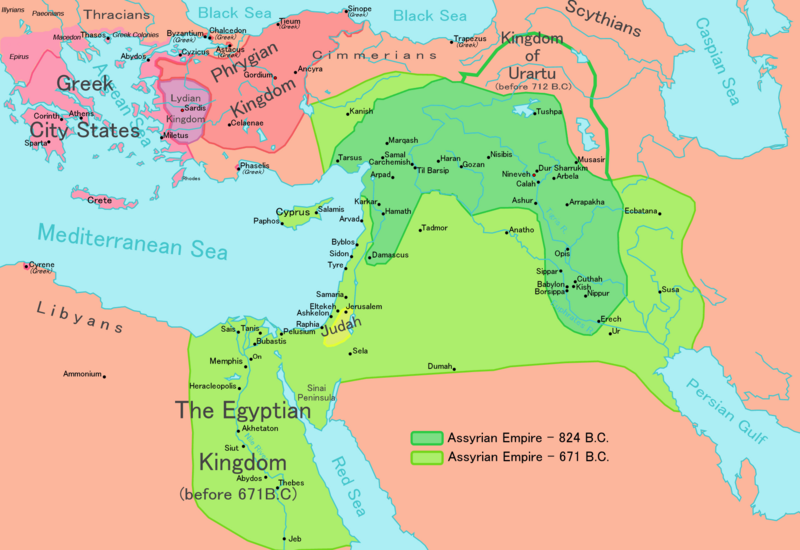
     As we would expect the Kingdom of Israel, who is doing avodah zarah and not establishing a just society, is eventually punished. The mechanism for their punishment in this case is the Assyrians, a Mesopotamia-based empire who have a resurgence around 800 BCE.


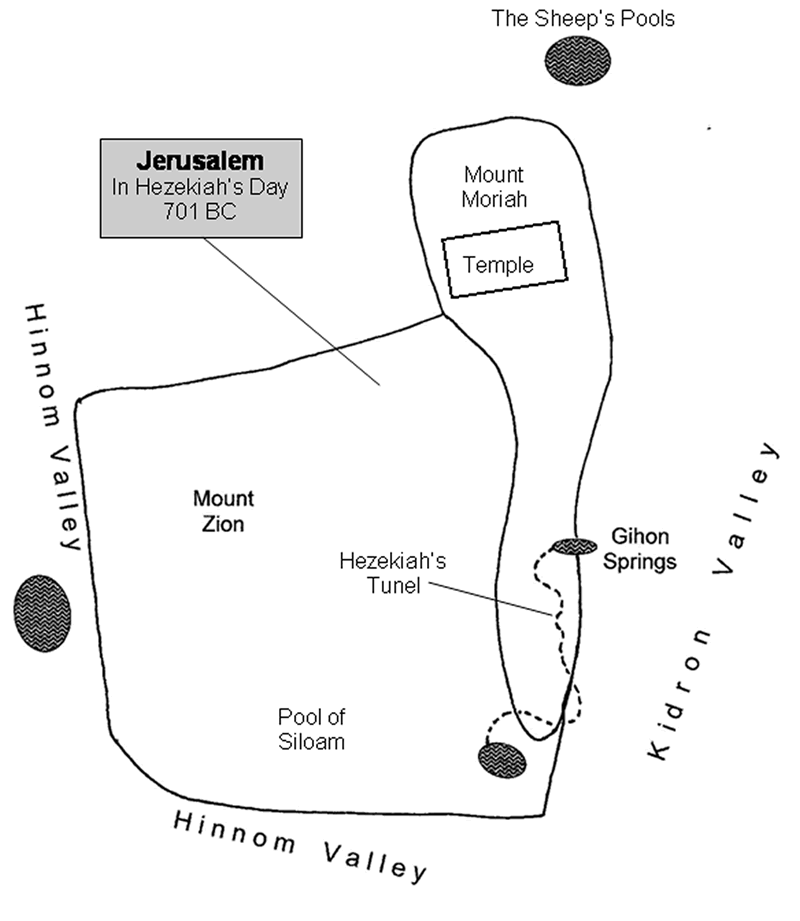
     In 722 BCE the Assyrians conquer Israel. Many of the citizens of Israel were deported, in line with Assyrian imperial policy. This destruction and subsequent deportation led to what is known as the ten lost tribes. As with any area in which there's a war there would certainly have been many people who chose to flee, some of them (if not most) to their southern neighbor, the Kingdom of Judah. As further proof for this phenomenon there is archaeological and historical evidence that the King of Judah at the time, Hezekiah, enlarged the walls of Yerushalayim considerably (the large square-ish part in the picture below), likely in part to accommodate the refugees.

The original city of David (right) and Hezekiah's Wall (left)
     20 years later Hezekiah decided to take advantage of unrest in Mesopotamia (the Assyrian homeland) to throw off the Assyrian yoke and declare independence. Among his preparations he improved the water tunnel to the Gihon spring, which you can see in the picture above. The Assyrians, after dealing with the unrest, arrived to Yehuda and devastated the entire country (such as we see in Lachish, for example). Having destroyed the rest of the country they arrive in 701 BCE to Yerushalayim, which they put to siege (I recommend reading about what it's like to be under siege, for example the relatively recent Siege of Leningrad or even the fictional siege of King's Landing in Game of Thrones, to get a sense of how scary and terrible it is). According to the Tanakh Hashem killed thousands of Assyrian soldiers, causing them to lift the siege and flee back to Mesopotamia. Other sources claim a plague ravaged the Assyrian ranks. Yet others say they left to, once again, deal with unrest in the homeland. All the sources agree Yerushalayim was saved. You can imagine the euphoria in the city as the Assyrians left. 
     One consequence of the "miraculous" departure of the Assyrian army is that the Yehudans came to believe that Hashem would never allow Yerushalayim, the holy city, to be conquered. Just over a hundred years later the Babylonians (also based in Mesopotamia) were the major power in the region. The King of Yehuda at this time decided to ally with the Egyptians against the Babylonians. Turns out he bet wrong. The ascendant Babylonians arrived to Yehuda and began a siege of Yerushalayim. Despite the prophet Jeremiah's cries to repent and warnings that Yerushalayim would be handed over to the Babylonian army, the King of Yehuda held firm, buoyed by the promises of false prophets (according to the Tanakh, I don't expect I could tell whether a prophet is true or false) and no doubt the memory of the miracle that saved Yerushalayim from the Assyrians. On the ninth of Av (a Hebrew month) the Babylonians destroyed Beit HaMikdash (the Temple); since then this has been a day of mourning for Am Yisrael (Tisha b'Av, the ninth of Av). The elites of Yehuda are sent in exile to Babylon, and after ~600 years living in our homeland in Eretz Yisrael we are sent into Galut Bavel (the Babylonian Exile). 
      Do you think Am Yisrael deserved this punishment? Is it divine? Is it simply the whim of history? If you heard this about another people, would you expect them to still be around thousands of years later?

Tuesday, February 9, 2016

Why Iran's Holocaust Denial Matters (more than you think)

     A couple of weeks ago was International Holocaust Remeberance Day, a day that was chosen because it is the anniversary of the liberation of Auschwitz (interestingly, Israel commemorates the Holocaust on a different day, related to the Warsaw Ghetto Uprising). To mark the event many international leaders gave speeches and held ceremonies. President Obama, for example gave a very moving speech at the Israeli Embassy. But in Iran (at least among the leadership), it was used as another opportunity to deny that the Holocaust happened (as you can see here and here). While denying the slaughter of millions of people is heinous, Iran's underlying motivation is even more important.
     In order to understand the Iranian view we first have to briefly try and understand Iranian history. Iran, called Persia for most of its history, has a long and glorious past. 2500 years ago they had the largest empire in the world. It was a bastion of tolerance (including toward the Jews) and civilization. And this wasn't an anomaly. Throughout history Persia has frequently been a major power. And, as with many of their Arab neighbors, this impressive history makes their current second-class status hard to stomach. In particular, much of the middle east has a great deal of trouble with the fact that the Jewish people--the world's punching bag for 2,000 years--have established a (mostly) successful, modern state, while they have completely failed to do so. And just as many Germans refused to accept their defeat in World War I (and gave rise to the Stab-in-the-back myth), many Iranians refuse to accept the facts and believe there must be some other force at work.
     So here's the story the Iranians tell (or at least the story their leadership officially endorses). One way or another the Jewish people convinced the west that the Holocaust happened. As a result, the Europeans and Americans felt really bad, came to the Middle East and stole land to give to the Jewish people. And, due to guilt over the (non-existent) Holocaust the UN voted to create a Jewish state. So the Iranians are saying 1) Israel exists because of the Holocaust and 2) this Holocaust didn't really happen. When they deny the Holocaust, what the Iranian leadership is really saying is that the raison d'etre for Israel's existence is a fabrication. While this is deeply offensive, the bigger problem is that this reasoning seems like it could be used to justify an existential attack on Israel. Why would it be a problem to erase a country that never should have existed in the first place?
     I feel a little bit silly pointing out the fallacies in Holocaust-deniers logic, so I'll keep it short. First of all, the Holocaust happened. Duh. (As my dad likes to say, "otherwise, where did all those European Jews go?") But even if you believe that it didn't, and you believe there are no historical Jewish ties to the land, there's clear evidence of modern Jewish settlement in the land of Israel dating back to the second half of the nineteenth century, long before the Holocaust. And, secondly, there's clear archaeological and textual evidence of Jewish settlement in the land of Israel as early as 1000 BCE, and if you want to be unreasonably conservative, no scholar in the world would question that there have been Jews living here since at least Roman times. There's also solid evidence of Jews visting and/or moving to Israel throughout the last 2000 years (like the Spanish poet Yehuda HaLevy in the twelfth century for example). So both claims that Holocaust deniers make are patently false; but that doesn't make their logic--and the story it tells--any less scary. 

Monday, February 8, 2016

King Shlomo (Solomon) and the Building of Beit HaMikdash (the Temple)

     After two awesome tiyulim (one a bit on the wet and cold side) we finally got back to the classroom. We'd left off our story talking about David HaMelech (King David), his accomplishments, his enduring importance, and, ultimately, his imperfections, especially the incident with Bathsheva. As part of his punishment for this behavior, we're told that David's house will be in constant turmoil, and this turns out to be the case. After revolts by his two oldest sons (Absalom and Adonijah, by custom/tradition/law the ones who should have taken over the kingship) eventually Shlomo (Solomon), his third eldest son (whose mother is Bathsheva) becomes king.
     Shlomo, like his father David, has some impressive accomplishments on his record. His wisdom is renowned to this day. Almost any westerner can recall Shlomo's judgement in the story about the two mothers arguing over the baby (I Kings 3:16-28). The Tanakh tells us that when granted one wish by Hashem, rather than riches or power or longevity, Shlomo asks to be a discerning judge (1 Kings 3:4). He's also known as a peaceful king. (On the one hand, a lovely trait, on the other, his two warlike predecessors might deserve some credit for mostly subduing the surrounding nations.) For these reasons and others it is Shlomo who gets to build Beit HaMikdash (the Temple). The Tanakh explains in detail exactly how it was built (It took seven years!) Here's one rendering of what it might have looked like according to the Tanakh:


     To build the Temple we are told that Shlomo conscripts the Israelites as laborers. When we talked about this in class the students had mixed opinions. Some pointed out that this is exactly the sort of thing Shmuel (Samuel) had warned the Israelites about when we demanded a king. Others said that the Temple would have more meaning because everyone participates in building it. Yet others agreed that building it as an Am was important, but wished Shlomo could have gone about it in a more diplomatic way (or maybe he did and the Tanakh simply doesn't include the details).
     Around this time (~1000 BCE is when Saul, David and Shlomo rule) it seems like the Jewish state reached the peak of its powers. As we've spoken about multiple times the traditional power centers in the Middle East are Mesopotamia (home of the Akkadians, Assyrians, Babylonians, et al.) and Egypt (and a bit later Asia Minor). A historical/scientific/rational explanation for the rise of the Jewish state during this time is that the Late Bronze Age Collapse (an unexplained near-disappearance of large settlements and fortifications) weakened the traditional power centers, leaving a vacuum that we filled. A more traditional explanation is some combination of good, moral behavior by the Israelites together with a leadership that was more or less responsive to Hashem's will. As is often the case my guess is that the truth is some combination of the two.
     At any rate the Tanakh offers several hints that Shlomo is the head of a powerful kingdom. For example, he's allied with the Phoenicians, a group living on what is today the Lebanese coast, renowned for their maritime activities (which makes sense historically, since Israel likely had a strong military presence on the ground, but little on the sea). We are also told that he has hundreds of wives, including one of Pharaoh's daughters. Also, the Tanakh says that dignitaries came from far and wide, seeking out Shlomo's wisdom. A particularly famous example is the Queen of Sheba, an African queen whose visit with Shlomo may have resulted in the Ethiopian Jews, only "discovered" in modern times (definitely a theory and not an established fact). Here's a map of the kingdom (in one of history's many ironies the kingdom was much larger than the current state, but the areas where the majority of the Israeli population lives today wasn't under Jewish sovereignty):


     As you may well be expecting given the chronicle of our Jewish heroes so far, Shlomo, too, has his faults. While he devotes seven years to building Beit HaMikdash he spends even longer building his own palace. Even worse, he allows his plethora of wives to lead him into avodah zarah (worshiping foreign gods). As a result of these indiscretions Hashem tells Shlomo that he will "tear the kingdom away" from him (1 Kings 11:11), leaving only one tribe in the possession of his family (the tribe of Yehuda). After Shlomo's reign it's downhill for Am Yisrael for a while (at least according to the Tanakh), but I'll save that for the next blog.
     Do you think Shlomo deserved to build Beit HaMikdash? Was it right/fair to force the Israelites to build it? Can you reconcile Shlomo's unparalleled wisdom with his decision to worship foreign gods? Is this an instance of power corrupting or something else? Should the fact that David and Shlomo controlled such a large territory influence the peace negotiations today? Let me know in the comments!

The Beginning of the Kingdom: Saul, David and the Establishment of Jewish Jerusalem

     When last we left Am Yisrael we had conquered the land, changed from a nomadic society to a settled one, and gone through the Judges cycle. On our tiyul this Sunday we began class talking about the end of the cycle, in which the tribe of Benjamin behaves in a terrible way (It's more R-rated than I'd care to be here, you can check it out in Judges 19 if you're interested). This continued deterioration in our moral behavior, along with our ongoing battles with our arch-enemies the Philistines, led the Israelites to ask for a king. Shmuel (Samuel), the prophet at the time, is angry at the Israelites; Hashem, he points out, is supposed to be our only king. He warns us against the things that kings do (and dictators do even today): impose heavy taxes, conscript whomever he needs into his army, etc. But Hashem tells him it's ok, that the Israelites are revolting against Hashem and not against him ("it's not you, it's me"), and we get our first king.
     Shaul (Saul) is from the tribe of Benjamin, the smallest tribe (likely connected to the fact that Benjamin was the youngest brother), which, at first may seem illogical. But often when communities choose a ruler, the other nobles, who are generally the ones doing the choosing, choose a weak leader so that they maintain as much power as possible for themselves. In the beginning Shaul is an excellent king, leading the Israelites in battle and establishing order among the 12 tribes. Eventually, however, he begins to ignore Hashem and follow his own whims (for example, rather than destroying the property of an enemy, as Hashem commands him, he keeps some for himself). We clearly see how vainglorious he becomes after David, who Shaul doesn't yet know will be the next king, kills Goliath. The people begin to sing "Shaul has killed his thousands, while David has killed his tens of thousands," which eventually leads Shaul to try and kill David out of jealousy. As you can imagine, Hashem is not thrilled with this behavior, and Shaul eventually dies in battle against the Philistines.
     His successor, David HaMelech (King David), is one of the most important people in Jewish history (and maybe even Western history in general). David is from the tribe of Yehuda, the biggest and strongest of the tribes, and when we first meet him he's still a child, the youngest of his brothers (a common thread among biblical Jewish leaders). When Shmuel (the prophet Samuel, mentioned above) is told to go to David's family's house David's father doesn't even think to present David, his youngest son who is out tending the animals. Shortly after Shmuel anoints David, signifying that he will be the next king, Shaul, who's already on Hashem's bad side, begins to have nightmares. And, wouldn't you know it, who do they find to come play the harp to soothe him but David HaMelech (who, according to tradition, used his talents to compose the book of Tehillim, or Psalms), who we, the reader, know is going to be the next king. Once again we see that the Tanakh is constructed like any excellent piece of literature; David, the king to be, becomes a favorite of Shaul, the king who's already on his way out. Fifty Shades of Grey's (or Pride and Prejudice for my parents) got nothin on the Tanakh!
     Next, we meet the Philistine giant Goliath, who's taunting the Israelites and challenging us to send our fiercest warrior out to face him in single combat. None of the Israelites is up to the challenge. Enter young David, who's only at the front to bring his now-soldier brothers some food from home (turns out sending care packages to soldiers isn't exactly new). When he brazenly decides to accept Goliath's challenge Shaul tries to give David his sword and armor, but David is so small that he can barely hold it, let alone use it, and so he goes out to face the renowned warrior with nothing but a slingshot and a whole lot of chutzpah (and some help from HaShem). As I'm sure most of you know he succeeds in killing Goliath, making him quite the celebrity among the Israelites (for better and for worse, as mentioned above). This event is one of the most famous of all time in the West, and in Israel it's the topic of a number of Israeli songs (Jewish culture alert!) like this silly one by the Israeli band Kaveret (with bad English translation).


Eventually, once Shaul dies, David becomes king, and makes his capital in Hevron (something to think about when we talk about the current negotiations with the Palestinians, since it's right in the middle of the West Bank), in Yehuda, his own tribe. Eventually, wanting to unite the 12 tribes, he moves his capital to Yerushalayim (Jerusalem).
     In class we've spoken a few times about the 4 Ds we look for in any ancient settlement: dinner (food), dollar (trade), defense and drink (water). Jerusalem is near fertile land and the Gihon spring, which covers two of the four. It's close to Derekh HaHar, the mountain highway, a much less important road than Derekh HaYam (the coastal highway), though not on it. So there's some trade, but probably not as much as there would have been at a place like Gezer. And while it's surrounded by valleys (we mentioned the Kidron Valley and Gai Ben Hinom Valley), the nearby mountains are considerably higher, making it less than optimal for defense purposes. Why, then, did David choose Yerushalayim? I've hinted at the first (and, in my opinion, most important) reason above, which is its politically important location on the border between two tribes. Similar to the early Americans' choice to make Washington D.C. our capital, David HaMelech didn't want his capital city to belong to any one tribe (What, you thought Americans were the first to have that idea?). Also, like D.C. (at least originally), Yerushalayim is in a relatively central location, making it more convenient to rule over all 12 tribes. The other reason David chose Yerushalayim is its religious importance; the site where Beit HaMikdash (the Temple) eventually stood (though not during David's reign) is where tradition says Avraham almost sacrificed Yitzhak. Whatever the reasons, David is the one who turned Yerushalayim into a Jewish capital, and it has been the spiritual center of Am Yisrael ever since.
     But even David isn't perfect. One day he sees Batsheva (who is married) bathing on her roof, falls in love with her (that's the nicest way to put it), and invites her to spend some "quality time" with him at the palace. She gets pregnant and, fearing that his indiscretion will become known, David arranges for her soldier husband to come home from the front for a quick visit, expecting him to enjoy the comforts of home (including his wife), providing a proper reason for her pregnancy. Unfortunately for David, her husband is such a good man that he can't imagine being at home while his fellow soldiers are out in the field, and so he sleeps outside the palace. The next night David gets him drunk, certain this will lead him home to his wife, but again he refuses. Finally, David tells his commander to send him into battle where the fighting is most intense, and just as David had intended, Bathseva's husband dies in battle, and David takes Batsheva as one of his wives.
     Not longe after this terrible incident Natan, David's prophet (both Shaul and David had prophets who were part of the leadership structure, providing something that today we might call a system of checks and balances), to report on an incident in the kingdom. Natan tells him that a traveler arrived to a town and requested a meal from a wealthy man with many animals. The wealthy man, not satisfied with his wealth, went and took the only sheep of a poor man. David, enraged, demands that this wealthy man be put to death, to which Natan replies, "That man is you!" David HaMelech, like all Jewish heroes, is imperfect. Due to the incident with Bathseva he is punished severely. He must constantly be at war (which he is, mostly with the Philistines). The child Batsheva is carrying will die. His sons will revolt against him (Absalom and Adonijah both do). And, perhaps most importantly, he is not allowed to build Beit HaMikdash (the Temple).
     Despite his moral failing in the Bathsheva incident we remember David HaMelech as a great king. Those taking a modern view of the Tanakh might say that part of this legacy comes from the fact that he's from the tribe of Yehuda, the last tribe standing (as we'll see tomorrow). It's certainly possible that later Yehudan author(s)/editor(s) changed the story. I, personally, find that an insufficient explanation. Thousands of years later his fame endures both in the common use of his name and as inspiration for various forms of art, two of which you'll find below.


     Does Yerushalayim carry special significance to the Jewish people? Was it just a politically convenient place to build a capital? Is it similar/different to how the French feel about Paris or Americans feel about Washintgon D.C.? Do its origins matter? Does David HaMelech deserve the adoration he receives? Was he just another king? Let me know in the comments!