On Sunday we were on an amazing tiyul (field trip) in the north of the country. We began at Beit Shearim, which is just southeast of Haifa, then cut across the country to Beit Alfa, which is near Beit She'an on Israel's Eastern border, and finished up with a dip in the beautiful Sachne Pools nearby. So why were we up north? After the destruction of Beit HaMikdash in 70 and the Bar Kochba revolt from 132 to 135 Jerusalem and the center of the country were completely destroyed and the center of Jewish life moved to the north. The Sanhedrin, for example, moved among places such as Tzippori, Beit Shearim and Tiberias (and is therefore known as the "Wandering Sanhedrin" during this time). During this time the most important development for Am Yisrael was the continued progression of the Torah she'be'al peh (Oral Torah or Oral law). I explained the principles behind the development of the Oral Torah in a previous post, but it's basically the tradition that was passed down to explain difficulties/incongruities in the written text, and by the arrival of the Romans (63 BCE) it was already a prominent part of Jewish thought. The destruction of Beit HaMikdash by Titus basically ended the Sadduccee sect, whose Judaism was based on Beit HaMikdash and who didn't accept the legitimacy of the Oral Torah, leaving only the Pharisees, now the leaders of Am Yisrael, and their academies, the centers where the Oral Law developed.
I've already mentioned a few of the most important Rabbis in this process: Hillel, who applied Hellenistic logic to Jewish law and developed hermeneutical principles (some of which will be familiar to modern lawyers, such as an "a fortiori" argument), and Yochanan ben Zakai, who fled the besieged Jerusalem, established an academy in Yavneh, and began to build a Judaism not based around Jerusalem and Beit HaMikdash. In my previous post I mentioned Rabbi Akiva, spiritual leader of the Bar Kochva revolt, who died gruesomely in an amphitheater while saying the Shema (the central statement of faith in Judaism). Rabbi Akiva is generally credited with beginning to organize the Oral Torah. As you can imagine the main way people studied the Tanakh was in order, beginning with Breisheet (Genesis) and proceeding through Shemot (Exodus), Vaykira (Leviticus), etc. But as we more explicitly defined the goal of study to be understanding which laws can be derived from the Tanakh this wasn't an effective method, so Rabbi Akiva organized the Oral Torah into six books, arranged by subject. Now, to learn about the laws regarding Shabbat, for example, you didn't have to search through several different books of the Tanakh and find the appropriate interpretation; you could simply look at the section dealing with laws about Shabbat.
One of the next major contributors to the Oral Torah (and obviously I'm leaving out many important people) was Rabbi Yehuda HaNasi, who is the reason we began our tiyul in Beit Shearim, where, according to tradition, he is buried. During the time when Yehuda HaNasi was active (around 200 CE) he noticed at least two main problems with the Oral Torah. First, given the number of Jews who had been killed during the two revolts and the ongoing persecution against Am Yisrael, he recognized the difficulty of depending on the tannaim (who memorized and passed on the Oral Torah), who might be killed at any moment. Second, he saw that as the process of Oral Law drew wider acceptance there were more and more interpretations to the various stories and laws. While this flourishing of Jewish thought certainly had many positive aspects, it also made it more likely for there to be a sect (or sects), such as the Christian Jews, who would eventually break away from Judaism. Given these realities he made the controversial decision to write down the Oral Torah, which he organized in the six categories developed by Rabbi Akiva and is today known as the Mishna.
Today, it seems quite obvious that writing down the Mishna (or anything else you want to preserve) is a good idea, but there are several problems. The first is that writing down the Oral Torah destroys one of its main advantages: its ability to adapt to new circumstances. Once its written down it loses its flexibility (and we'll see how Am Yisrael deals with this problem in a later blog). Another main concern is that in writing down the Oral Torah Yehuda HaNasi had to decide which traditions/interpretations to include and which to leave out. In explaining this to the students I asked them to consider what they would write today if they had to make an official determination about what is Jewish. Most Jews would clearly describe someone who wears a kippah, prays three times a day, studies Torah and behaves in a morally just way as Jewish, and most Jews would clearly describe someone who goes to church every week and accepts Jesus as his personal savior as non-Jewish. The question is where do we draw the line? Does being Jewish only mean behaving ethically? Does it mean a minimum number of visits to Beit Knesset every week/month/year? Does it mean celebrating Jewish holidays, or speaking Hebrew? If I "feel Jewish" does that make me Jewish? It's obviously a very difficult question to answer, and I hope you'll share your own view in the comments.
Also on this tiyul we saw what it was like for Am Yisrael to live as a minority among a strong majority culture (sound familiar?) and the influences the majority culture can have. At Beit Shearim we saw rabbis' graves with pictures of eagles, the symbol of Rome, and even Nike, the goddess of victory. At Beit Alpha we saw the beautiful mosaic floor of a Beit Knesset, which had a picture of the Roman sun god Helios in the middle.
After seeing these somewhat surprising images in slightly uncomfortable places I asked the students what they made of it, and how they thought it compared to their modern day lives. Many of them accepted the ubiquity of modern American Christian culture (I think about half had sung Christmas songs as part of being in Chorus class), but still felt like these particular instances were going too far (a foreign god in a beit knesset!). Both of these discussions were incredibly interesting, and I hope the students (and anyone else who's interested!) will share their thoughts in the comments. A few of them also wrote about which cultural practices and symbols we can adapt and use as Jews in their own blogs, so check them out!
I've already mentioned a few of the most important Rabbis in this process: Hillel, who applied Hellenistic logic to Jewish law and developed hermeneutical principles (some of which will be familiar to modern lawyers, such as an "a fortiori" argument), and Yochanan ben Zakai, who fled the besieged Jerusalem, established an academy in Yavneh, and began to build a Judaism not based around Jerusalem and Beit HaMikdash. In my previous post I mentioned Rabbi Akiva, spiritual leader of the Bar Kochva revolt, who died gruesomely in an amphitheater while saying the Shema (the central statement of faith in Judaism). Rabbi Akiva is generally credited with beginning to organize the Oral Torah. As you can imagine the main way people studied the Tanakh was in order, beginning with Breisheet (Genesis) and proceeding through Shemot (Exodus), Vaykira (Leviticus), etc. But as we more explicitly defined the goal of study to be understanding which laws can be derived from the Tanakh this wasn't an effective method, so Rabbi Akiva organized the Oral Torah into six books, arranged by subject. Now, to learn about the laws regarding Shabbat, for example, you didn't have to search through several different books of the Tanakh and find the appropriate interpretation; you could simply look at the section dealing with laws about Shabbat.
One of the next major contributors to the Oral Torah (and obviously I'm leaving out many important people) was Rabbi Yehuda HaNasi, who is the reason we began our tiyul in Beit Shearim, where, according to tradition, he is buried. During the time when Yehuda HaNasi was active (around 200 CE) he noticed at least two main problems with the Oral Torah. First, given the number of Jews who had been killed during the two revolts and the ongoing persecution against Am Yisrael, he recognized the difficulty of depending on the tannaim (who memorized and passed on the Oral Torah), who might be killed at any moment. Second, he saw that as the process of Oral Law drew wider acceptance there were more and more interpretations to the various stories and laws. While this flourishing of Jewish thought certainly had many positive aspects, it also made it more likely for there to be a sect (or sects), such as the Christian Jews, who would eventually break away from Judaism. Given these realities he made the controversial decision to write down the Oral Torah, which he organized in the six categories developed by Rabbi Akiva and is today known as the Mishna.
Today, it seems quite obvious that writing down the Mishna (or anything else you want to preserve) is a good idea, but there are several problems. The first is that writing down the Oral Torah destroys one of its main advantages: its ability to adapt to new circumstances. Once its written down it loses its flexibility (and we'll see how Am Yisrael deals with this problem in a later blog). Another main concern is that in writing down the Oral Torah Yehuda HaNasi had to decide which traditions/interpretations to include and which to leave out. In explaining this to the students I asked them to consider what they would write today if they had to make an official determination about what is Jewish. Most Jews would clearly describe someone who wears a kippah, prays three times a day, studies Torah and behaves in a morally just way as Jewish, and most Jews would clearly describe someone who goes to church every week and accepts Jesus as his personal savior as non-Jewish. The question is where do we draw the line? Does being Jewish only mean behaving ethically? Does it mean a minimum number of visits to Beit Knesset every week/month/year? Does it mean celebrating Jewish holidays, or speaking Hebrew? If I "feel Jewish" does that make me Jewish? It's obviously a very difficult question to answer, and I hope you'll share your own view in the comments.
Also on this tiyul we saw what it was like for Am Yisrael to live as a minority among a strong majority culture (sound familiar?) and the influences the majority culture can have. At Beit Shearim we saw rabbis' graves with pictures of eagles, the symbol of Rome, and even Nike, the goddess of victory. At Beit Alpha we saw the beautiful mosaic floor of a Beit Knesset, which had a picture of the Roman sun god Helios in the middle.
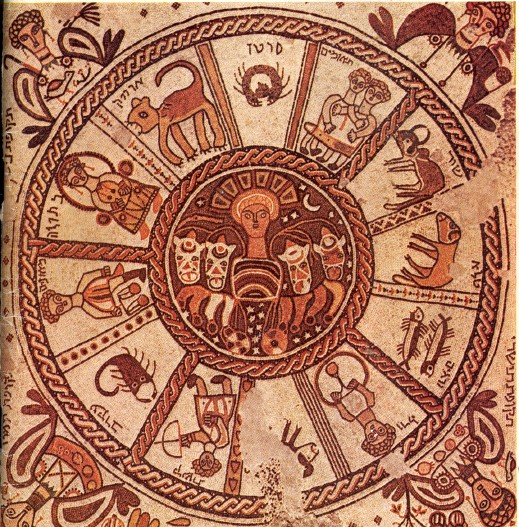 |
| part of the mosaic floor in the beit knesset at beit alpha showing the god Helios |


