Saturday, February 14, 2015

Divided Kingdom, the end of Israel and the Destruction of the First Temple

     Before Shlomo's (Solomon) death an Israelite named Jerobaum was unhappy with Shlomo's rule, attempted some sort of revolt, and then fled to Egypt. When Shlomo died Jerobaum returned and went to speak with Shlomo's heir, Rehobaum. Jerobaum asked him to lighten the tax burden (if you recall Shlomo required a great deal from the Israelites both to build the Temple and his palace), promising eternal support if Rehobaum would only make things a little bit easier for the people. Rehobaum seeks the advice of the elders, who encourage him to accede to Jerobaum's request. Rehobaum then consults his young friends (I like to think of them as the rich kids who's parents never told them "no") who disagree with the elders, advising Rehobaum to tell Jerobaum "My little finger is thicker than my father's loins. My father imposed a heavy yoke on you, and I will add to your yoke; my father flogged you with whips, but I will flog you with scorpions." (1 Kings 12:10-11, JPS translation) Unfortunately, Rehobaum, the new king, who should be trying to consolidate his rule takes the advice of his young friends. Great politician, huh?
     Obviously, Jerobaum can't accept this, and the 10 tribes of the north secede (~930 BCE) to form the Kingdom of Israel, leaving Rehobaum in charge of the Kingdom of Yehuda (Judah). At this point several prophecies have come true. Shmuel, when the Israelites originally asked for a king, warned them how oppressive a king would be. Hashem, in response to Shlomo's avodah zara (worship of foreign gods) tells him that his descendants will rule over only one tribe. We see here that both of those things have now come true. From now on there will be two Jewish states: Israel in the north and Yehuda in the south. After the split the two kingdoms spend several decades fighting each other before arriving at some sort of peace agreement. 
After Shlomo there are two Jewish states: Israel in the north and Yehuda in the south
     According to the Tanakh the kingdom of Israel quickly deteriorates into avodah zarah (worship of foreign gods). In class, for example we spoke about King Ahab and his Phoenician wife Jezebel, who persecute those who worship Hashem (the story begins toward the end of the first book of Kings, 1 Kings 18 will give you the idea). According to more traditional measures (military/economic power, for example), Israel is clearly the more powerful and successful of the two kingdoms.
     It is during this period that the later prophets, such as Eliyahu HaNavi (Elijah the prophet), become active. The early prophets, such as Shmuel (Samuel) and Natan (Nathan), were part of the leadership structure. In modern terms they provided a sort of balance of power to the kings Shaul (Saul) and David respectively. The later prophets are decidedly outside the government. Eliyahu, as is typical of the later prophets, is actually pursued by Ahab and (especially) Jezebel, who want to kill him in retribution for killing the prophets of Jezebel's foreign gods. We also looked briefly at the episode after Eliyahu flees, in which he is hiding in a cave and Hashem tells him that there will be no more large demonstrations of power (Hashem had just publicly helped Eliyahu prove that Hashem is the one and only God), but Hashem will now be a "soft murmuring sound" (also translated as "a still, small voice", if you want to see the Hebrew it's 1 Kings 19:12). This seems to answer the often asked question, "Why are there no more miracles like we see in the Tanakh?" Do you think Hashem decided to influence the world in a different way, stop actively influencing it completely, or was this simply added later to explain away the lack of big, obvious miracles?
     As we would expect the Kingdom of Israel, who is doing avodah zarah, is eventually punished. The mechanism for their punishment in this case is the Assyrians, a Mesopotamia-based empire who have a resurgence around 800 BCE.


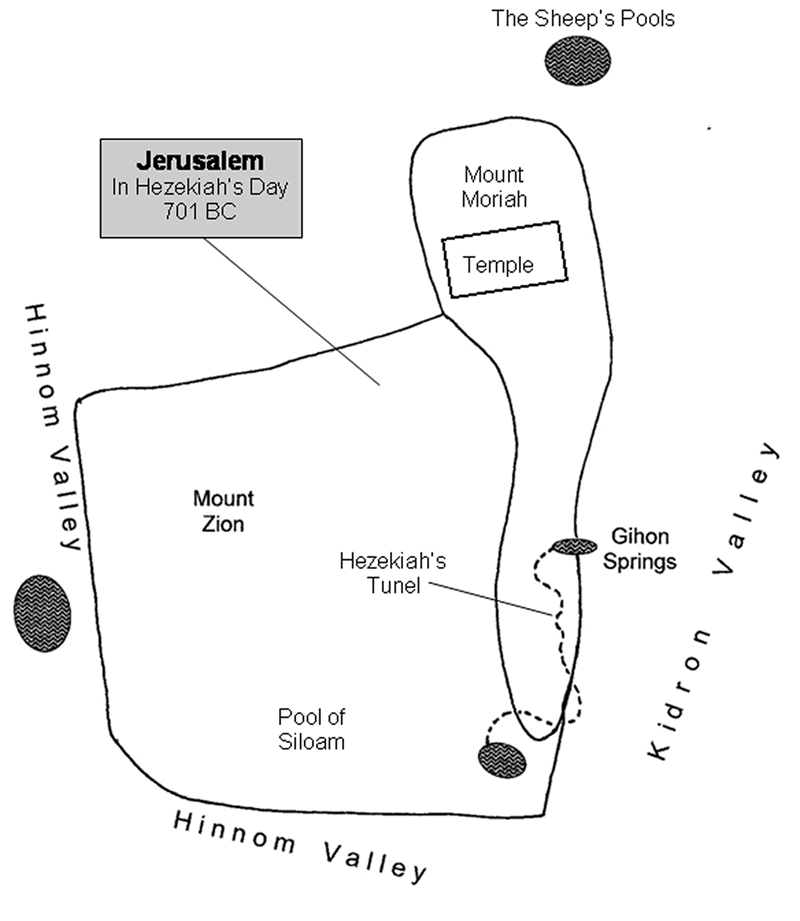
     In 722 BCE the Assyrians conquer Israel. Many of the citizens of Israel were deported, in line with Assyrian imperial policy. This destruction and subsequent deportation led to what is known as the 10 lost tribes. As with any area in which there's a war there would certainly have been many people who chose to flee, some of them (if not most) to their southern neighbor, the Kingdom of Judah. As further proof for this phenomenon there is archaeological and historical evidence that the King of Judah at the time, Hezekiah, enlarged the walls of Yerushalayim considerably (the large square-ish part in the picture below), likely in part to accommodate the refugees.

The original city of David (right) and Hezekiah's Wall (left)
     20 years later Hezekiah decided to take advantage of unrest in Mesopotamia (the Assyrian homeland) to throw off the Assyrian yoke and declare independence. Among his preparations he improved the water tunnel to the Gihon spring, which you can see in the picture above. The Assyrians, after dealing with the unrest, arrived to Yehuda and devastated the entire country (such as we see in Lachish, for example). Having destroyed the rest of the country they arrive in 701 BCE to Yerushalayim, which they put to siege (I've recommended to the students several times to read about what it's like to be under siege, for example the relatively recent Siege of Leningrad or even the fictional siege of King's Landing in Game of Thrones, to get a sense of how scary and terrible it is). According to the Tanakh Hashem killed thousands of Assyrian soldiers, causing them to lift the siege and flee back to Mesopotamia. Other sources claim a plague ravaged the Assyrian ranks. Yet others say they left to, once again, deal with unrest in the homeland. All the sources agree Yerushalayim was saved. You can imagine the euphoria in the city as the Assyrians left. 
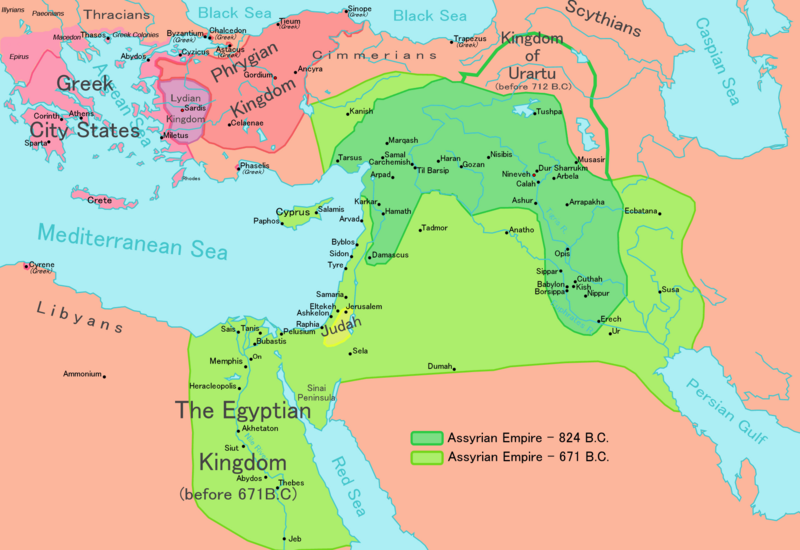
     One consequence of the "miraculous" departure of the Assyrian army is that the Yehudans came to believe that Hashem would never allow Yerushalayim, the holy city, to be conquered. Just over a hundred years later the Babylonians (also based in Mesopotamia) were the major power in the region. The King of Yehuda at this time decided to ally with the Egyptians against the Babylonians. It turns out he bet wrong. The ascendant Babylonians arrived to Yehuda and began a siege of Yerushalayim. Despite the prophet Jeremiah's cries to repent and warnings that Yerushalayim would be handed over to the Babylonian army, the King of Yehuda held firm, buoyed by the promises of false prophets (according to the Tanakh, I don't expect I could tell whether a prophet is true or false) and no doubt the memory of the miracle that saved Yerushalayim from the Assyrians. On the ninth of Av (a Hebrew month) the Babylonians destroyed Beit HaMikdash (the Temple); since then this has been a day of mourning for Am Yisrael (Tisha b'Av, the ninth of Av). The elites of Yehuda are sent in exile to Babylon, and after ~600 years living in our homeland in Eretz Yisrael we are sent into Galut Bavel (the Babylonian Exile). 
      Do you think Am Yisrael deserved this punishment? Is it divine? Is it simply the whim of history? If you heard this about another people, would you expect them to still be around thousands of years later?

Shlomo HaMelech (King Solomon) and the building of Beit HaMikdash (the Temple)

     After two awesome days on tiyul we finally got back to the classroom. We'd left off our story talking about David HaMelech (King David), his accomplishments, his enduring importance, and, ultimately, his imperfections, especially the incident with Bathsheva. As part of his punishment for this behavior, we're told that David's house will be in constant turmoil, and this turns out to be the case. After revolts by his two oldest sons (Absalom and Adonijah, by custom/tradition/law the ones who should have taken over the kingship) eventually Shlomo (Solomon), his third eldest son (whose mother is Bathsheva) becomes king.
     Shlomo, like his father David, has some impressive accomplishments on his record. His wisdom is renowned to this day. Almost any westerner can recall Shlomo's judgement in the story about the two mothers arguing over the baby. The Tanakh tells us that when granted one wish by Hashem, rather than riches or power or longevity, Shlomo asks to be a discerning judge (1 Kings 3:4). He's also known as a peaceful king. (On the one hand, a lovely trait, on the other, his two warlike predecessors might deserve some credit for mostly subduing the surrounding nations.) For these reasons and others it is Shlomo who gets to build Beit HaMikdash (the Temple). The Tanakh explains in detail exactly how it was built (It took seven years!) Here's one rendering of what it might have looked like according to the Tanakh:


     To build the Temple we are told that Shlomo conscripts the Israelites as laborers. When we talked about this in class the students had mixed opinions. Some pointed out that this is exactly the sort of thing Shmuel (Samuel) had warned the Israelites about when we demanded a king. Others said that the Temple would have more meaning because everyone participates in building it. Yet others agreed that building it as an Am was important, but wished Shlomo could have gone about it in a more diplomatic way (or maybe he did and the Tanakh simply doesn't include the details).
     Around this time (~1000 BCE is when Saul, David and Shlomo rule) it seems like the Jewish state reached the peak of its powers. As we've spoken about multiple times the traditional power centers in the Middle East are Mesopotamia (home of the Akkadians, Assyrians, Babylonians, et al.) and Egypt (and a bit later Asia Minor). A historical/scientific/rational explanation for the rise of the Jewish state during this time is that the Late Bronze Age Collapse weakened the traditional power centers, leaving a vacuum that we filled. A more traditional explanation is some combination of good, moral behavior by the Israelites together with a leadership that was more or less responsive to Hashem's will. As is often the case my guess is that the truth is some combination of the two.
     At any rate the Tanakh offers several hints that Shlomo is the head of a powerful kingdom. For example, he's allied with the Phoenicians, a group living on what is today the Lebanese coast, renowned for their maritime activities (which makes sense historically, since Israel likely had a strong military presence on the ground, but little on the sea). We are also told that he has hundreds of wives, including one of Pharaoh's daughters. Also, the Tanakh says that dignitaries came from far and wide, seeking out Shlomo's wisdom. A particularly famous example is the Queen of Sheba, an African queen whose visit with Shlomo may have resulted in the Ethiopian Jews, only "discovered" in modern times (definitely a theory and not an established fact). Here's a map of the kingdom (in one of history's many ironies the kingdom was much larger than the current state, but the areas where the majority of the Israeli population lives today wasn't under Jewish sovereignty):


     As you may well be expecting given the chronicle of our Jewish heroes so far, Shlomo, too, has his faults. While he devotes seven years to building Beit HaMikdash he spends even longer building his own palace. Even worse, he allows his plethora of wives to lead him into avodah zarah (worshiping foreign gods). As a result of these indiscretions Hashem tells Shlomo that he will "tear the kingdom away" from him (1 Kings 11:11), leaving only one tribe in the possession of his family (the tribe of Yehuda we see later). After Shlomo's reign it's downhill for Am Yisrael for a while (at least according to the Tanakh), but I'll save that for the next blog.
     Do you think Shlomo deserved to build Beit HaMikdash? Was it right/fair to force the Israelites to build it? Can you reconcile Shlomo's unparalleled wisdom with his decision to worship foreign gods? Is this an instance of power corrupting or something else? Should the fact that Shlomo controlled such a large territory influence the peace negotiations today? Let me know in the comments!

The United Kingdom: David, Saul and the Establishment of Jerusalem as the Jewish Capital

     When last we left Am Yisrael we had conquered the land, changed from a nomadic society to a settled one, and gone through the Judges cycle. On our tiyul last Sunday we began class talking about the end of the cycle (after reading an interview with Stav Shaffir, which you can find in this earlier blog), in which the tribe of Benjamin behaves in a terrible way (It's more R-rated than I'd care to be here, you can check it out in Judges 19 if you're interested). This continued deterioration in our moral behavior, along with our ongoing battles with our arch-enemies the Philistines, led the Israelites to ask for a king. Shmuel (Samuel), the prophet at the time, is angry at the Israelites; Hashem, he points out, is supposed to be our only king. He warns us against the things that kings do (and dictators do even today): impose heavy taxes, conscript whomever he needs into his army, etc. But Hashem tells him it's ok, that the Israelites are revolting against Hashem and not against him ("it's not you, it's me"), and we get our first king.
     Shaul (Saul) is from the tribe of Benjamin, the smallest tribe (likely connected to the fact that Benjamin was the youngest brother), which, at first may seem illogical. But often when communities choose a ruler, the other nobles, who are generally the ones doing the choosing, often choose a weak leader so that they maintain as much power as possible for themselves. In the beginning Shaul is an excellent king, leading the Israelites in battle and establishing order among the 12 tribes. Eventually, however, he begins to ignore Hashem and follow his own whims (for example rather than destroying the property of an enemy, as Hashem commands him, he keeps some for himself). We clearly see how vainglorious he becomes after David, who Shaul doesn't yet know will be the next king, kills Goliath. The people begin to sing "Shaul has killed his thousands, while David has killed his tens of thousands," which eventually leads Shaul to try and kill David out of jealousy. As you can imagine, Hashem is not thrilled with this behavior, and Shaul eventually dies in battle against the Philistines.
     His successor, David HaMelech (King David), is one of the most important people in Jewish history (and maybe even Western history in general). David is from the tribe of Yehuda, the biggest and strongest of the tribes, and when we first meet him he's still a child, the youngest of his brothers (a common thread among Biblical Jewish leaders). When Shmuel (the prophet Samuel, mentioned above) is told to go to David's family's house David's father doesn't even think to present David, his youngest son who is out tending the animals. Shortly after Shmuel anoints David, signifying that he will be the next king, Shaul, who's already on Hashem's bad side, begins to have nightmares. And, wouldn't you know it, who do they find to come play the harp to soothe him but David HaMelech (who, according to tradition, used his talents to compose the book of Tehillim, or Psalms), who we, the reader, know is going to be the next king. Once again we see that the Tanakh is constructed like any excellent piece of literature; David, the king to be, becomes a favorite of Shaul, the king who's already on his way out. Fifty Shades of Grey's (or Pride and Prejudice for my parents) got nothin on the Tanakh!
     Next, we meet the Philistine giant Goliath, who's taunting the Israelites and challenging us to send our fiercest warrior out to face him in single combat. None of the Israelites is up to the challenge. Enter young David, who's only at the front to bring his now-soldier brothers some food from home (turns out sending care packages to soldiers isn't exactly new). When he brazenly decides to accept Goliath's challenge Shaul tries to give David his sword and armor, but David is so small that he can barely hold it, let alone use it, and so he goes out to face the renowned warrior with nothing but a slingshot and a whole lot of chutzpah. As I'm sure most of you know he succeeds in killing Goliath, making him quite the celebrity among the Israelites (for better and for worse, as mentioned above). This event is one of the most famous of all time in the West, and in Israel it's the topic of a number of Israeli songs (Jewish culture alert!) like this silly one by the Israeli band Kaveret (with bad English translation).


Eventually, once Shaul dies, David becomes king, and makes his capital in Hevron (something to think about when we talk about the current negotiations with the Palestinians), in Yehuda, his own tribe. Eventually, wanting to unite the 12 tribes, he moves his capital to Yerushalayim (Jerusalem).
     In class we've spoken a few times about the 4 Ds we look for in any ancient settlement: dinner (food), dollar (trade), defense and drink (water). Jerusalem is near fertile land and the Gihon spring, which covers two of the four. It's close to Derekh HaHar, the mountain highway, a much less important road than Derekh HaYam (the coastal highway), though not on it. So there's some trade, but probably not as much as there would have been at a place like Gezer. And while it's surrounded by valleys (we mentioned the Kidron Valley and Gai Ben Hinom Valley), the nearby mountains are considerably higher, making it less than optimal for defense purposes. Why, then, did David choose Yerushalayim? I've hinted at the first (and, in my opinion, most important) reason above, which is its politically important location on the border between two tribes. Similar to the early Americans' choice to make Washington D.C. our capital, David HaMelech didn't want his capital city to belong to any one tribe (What, you thought Americans were the first to have that idea?). Also, like D.C. (at least originally), Yerushalayim is in a relatively central location, making it more convenient to rule over all 12 tribes. The other reason David chose Yerushalayim is its religious importance; the site where Beit HaMikdash (the Temple) eventually stood (though not during David's reign) is where tradition says Avraham almost sacrificed Yitzhak. Whatever the reasons David is the one who turned Yerushalayim into a Jewish capital, and it has been the spiritual center of Am Yisrael ever since.
     But even David isn't perfect. One day he sees Batsheva (who is married) bathing on her roof, falls in love with her (that's the nicest way to put it), and invites her to spend some quality time with him at the palace. Fearing that his indiscretion will become known he arranges for her soldier husband to come home from the front for a quick visit, expecting him to enjoy the comforts of home (including his wife), providing a proper reason for her pregnancy. Unfortunately for David, her husband is such a good man that he can't imagine being at home while his fellow soldiers are out in the field, and so he sleeps outside the palace. The next night David gets him drunk, certain this will lead him home to his wife, but again he refuses. Finally, David tells his commander to send him into battle where the fighting is most intense, and just as David had intended, Bathseva's husband dies in battle, and David takes Batsheva as one of his wives.
     Not longer after this terrible incident Natan, David's prophet (both Shaul and David had prophets who were part of the leadership structure, providing something that today we might call a system of checks and balances), to report on an incident in the kingdom. Natan tells him that a traveler arrived to a town and requested a meal from a wealthy man with many animals. The wealthy man, not satisfied with his wealth, went and took the only sheep of a poor man. David, enraged, demands that this wealthy man be put to death, to which Natan replies, "That man is you!" David HaMelech, like all Jewish heroes, is imperfect. Due to the incident with Bathseva he is punished severely. He must constantly be at war (which he is, mostly with the Philistines). The child Batsheva is carrying will die. His sons will revolt against him (Absalom and Adonijah both do). And, perhaps most importantly, he is not allowed to build Beit HaMikdash (the Temple).
     Despite his moral failing in the Bathsheva incident we remember David HaMelech as a great king. Those taking a modern view of the Tanakh might say that part of this legacy comes from the fact that he's from the tribe of Yehuda, the last tribe standing (as we'll see tomorrow). It's certainly possible that later Yehudan author(s)/editor(s) changed the story. I, personally, find that an insufficient explanation. Thousands of years later his fame endures both in the common use of his name and as inspiration for various forms of art, two of which you'll find below.


     Does Yerushalayim carry special significance to the Jewish people? Was it just a politically convenient place to build a capital? Is it similar/different to how the French feel about Paris or Americans feel about Washintgon D.C.? Do its origins matter? Does David HaMelech deserve the adoration he receives? Was he just another king? Let me know in the comments!

Israel Elections Update: What's the future of the Arab political parties?

     As we get closer to elections here in Israel there are lots of polls. In general, these polls tend to be less accurate than in America. I imagine there are a few reasons for this: the multitude of different parties, the fact that we're so much smaller than the US (meaning there are comparatively less resources devoted to elections and election polling) or simply the fact that Nate Silver's not Israeli. But at this point it seems likely that Labor and Likud will be the two largest parties in some order and, even if Labor wins, they will have a tough time forming a coalition (joining together with other parties to reach a minimum of 61 members of the 120 seat Knesset). According to this recent poll by the Times of Israel (and I encourage you to read the article, which, among other things, shows Netanyahu's falling popularity) for example, Labor is likely to get the most seats with 27. Their most likely coalition partners (in my opinion) would be Yesh Atid (centrist, this poll has them at 11 seats), Kulanu (centrist but a little more to the right, this poll has them at 10 seats) and Meretz (the most left wing party in the Knesset, this poll has them at 4 seats). Together, this gets them to a total of 53 seats. Their only options for forming a government, assuming they can't entice Likud or one of the other right wing parties (Yisrael Beiteinu-Israel Our Home and HaBayit HaYehudi-The Jewish Home) to join them is to invite the Ultra-orthodox parties (16 seats according to this poll) or the Arab party (11 seats according to this poll). All of these options are problematic.
     First of all, I feel compelled to remind us all of the old adage that "politics makes strange bedfellows", and anything can happen, but I find all of these scenarios unlikely. The right far right parties would have to make extremely deep ideological compromises to join a Labor government. Likud, having just come off years of being in charge, is unlikely, in my view to feel the need to make compromises just for the sake of remaining in the governing coalition, especially if there's a chance that Labor can't form a government (which makes it likely Likud would be asked to do so). The ultra-orthodox have been Israel's kingmakers for years; our political system makes them ideal partners, since they'll support much of a major party's agenda in exchange for a few very specific concessions. But in the last few years there has been rising anger over their unwillingness to "contribute to society" through army service or joining the workforce (many if not most ultra-orthodox men spend their whole lives studying in yeshiva, neither joining the army or getting a job). Especially on the left I think there would be great anger over the compromises that would be necessary to convince the ultra-orthodox to join the government. This leaves the United Arab List.
     In the history of Israel no Arab party has ever been a part of the governing coalition and it seems exceedingly unlikely that it will happen this time. However, there have been important changes that I think make it more likely that we will see this happen in my lifetime. In this past Knesset they raised the minimum number of seats required in order to be a part of the Knesset (ie you have to get at least four seats in order to be in the Knesset), to try and reduce the number of smaller parties. This means that many of the current Arab parties will be very close to threshold if they run independently in the upcoming elections. As a result they have joined together for the first time on the United Arab List, which, according to the poll, is likely to get something like 11 seats, giving them more power than they have ever had (this is a link to an article specifically looking at this issue, not the poll I linked to above). There is some evidence (still very unclear) that the unification of the Arab parties will increase the historically-low Arab voter turnout as well, which could dramatically influence the results. Even the currently predicted 11 seats will leave them vastly under-represented compared to their percentage of the population (Israeli Arabs are about 20% of the population, which means they "should" have ~24 seats in the Knesset).
     The fact that the Arab community votes at very low levels and have been divided among a number of different parties has given them less political power than they could have. For some Israeli-Arabs, they don't vote for ideological reasons; they don't recognize the legitimacy of the Jewish state. For others, they believe that Israel won't respond to their needs no matter what, so why vote? And, of course, as with any other democratic elections, some people just don't vote. In my (American, democracy is the-best-thing-in-the-world) opinion, this has been a major blunder on their part. If they received anything close to the number of seats their population suggests they should they would be a major political force, as opposed to the fringe players they have been so far.
     I moved to Israel in order to live in a Jewish state, and I would be deeply disappointed, if, all of a sudden, we stopped being one. So I acknowledge the very problematic situation of Israeli Arabs who want to live in an Arab state, and/or won't acknowledge the legitimacy of the Jewish state. On the other hand, Jews have been a successful minority and a major part of society in dozens of societies over hundreds of years (ancient Rome, Golden Age Spain, modern day America, etc.) so I recognize this possibility as well. I think this is a particularly apt comparison, since these Jewish minorities, even in the best of times, were often treated significantly worse than modern Arab Israelis. While there is definitely discrimination against Arab Israelis, I also think they are one of the best-treated minorities of all time (which is not to say that we shouldn't do even more to prevent discrimination). I think our treatment of Israeli Arabs compares favorably to the situation of Christians in the Arab world, for example.
     If the Arab minority were willing to accept their place as a minority in a Jewish state they would have the political power to demand far more government support for their communities. I am nowhere near knowledgeable enough about the Arab-Israeli community to venture a guess as to whether this is the direction they're moving or not, but I think ("hope" might be a better word here) there are at least some reasons for optimism. First I hope that the further we get from the War of Independence (1948) the less raw the wounds will be for Israeli-Arabs. Second, I hope that as generations of Israeli-Arabs grow up in a Jewish state they will feel more connected to Israeli society (and we should be making every effort to make this the case). Third, after nearly 70 years of existence I hope they will accept our presence here as a fact. Fourth, as the various states around the Middle East collapse, I hope they will appreciate the stability and rule of law (again, I acknowledge there is at least some measure of anti-Arab discrimination, but I feel confident they'd prefer to live here than in Syria) here in Israel. Lastly, and perhaps most importantly, I hope they will feel like it is in their own self-interest. If they accept their minority status they could be a much more meaningful part of Israeli politics and improve the lives of their community, which would be good for all of us.
     Do you think it's reasonable for us as Jews who demand to live in a Jewish state to expect Israeli-Arabs to give up on the idea of living in an Arab state? Do you think Arab parties can be a part of the governing coalition? Would it require some sort of public declaration accepting Israel as a Jewish state on their part? Is that a fair request? Are there other ways Israel can try and more fully incorporate our Arab minority? Will we begin to see more Israeli-Arabs on other parties' lists? Do they have a future in Israel? Let me know in the comments!

Stav Shaffir: Labor's Rising Star

     If you're young, Israeli and anywhere to the left of our current Prime Minister there's a good chance you're at least a little bit in love with Israeli's youngest Knesset member, 27 year old Stav Shaffir. Shaffir rose to prominence by leading the massive cost-of-living protests in 2011 (the ones that helped contribute to the rise of the Occupy Wall Street movement). Since then she's entered politics as a member of the Labor Party, and is currently number four on Labor's list of candidates, meaning she will definitely be in the next Knesset. She recently sat down for an interview with David Horovitz, the founding editor of the Times of Israel, an English language site (also in French, Arabic and Chinese) frequently featured on this blog. You should definitely check it out.
     While reading the interview it's important to remember that she's a politician running for office, so we should hardly be surprise that she's anti-corruption. What politician isn't? On the other hand, it certainly seems like she's made a serious effort to improve transparency and the overall quality of governance. She's officially the least well-off member of the Knesset and one of only eight to refuse a raise. She publishes the hours she works. She's established a committee of volunteers to help sift through the vast technical jargon that makes up the budget. These actions are definitely good publicity, but that doesn't mean they're not how we should want our Knesset members to behave.
      One of the most interesting aspects of the interview for Americans, in my opinion, is that she frames her positions in terms of Zionism. In America candidates often try to frame themselves as the "most American", and the other candidate as "un-American". In Israel we talk about Zionism. Shaffir, as a member of the left, has certainly been attacked (and will be in the future) as anti-Zionist and an Arab apologist. Members of the right will say she's soft on security and that her willingness to give up land and make peace is unrealistic and dangerous. Shaffir's response in this interview is to lay out a Zionism that is not just about security. She claims that the right, and Netanyahu in particular, can only offer a Zionism of fear. She explains
The political right is Zionism without content. Can it be better here? No. Can ordinary people manage here financially? No. When we protested, Bibi mocked us. We called for affordable housing, affordable public transport. Bibi answered, be glad you’re alive and stop moaning. Fear and that’s it; we can’t change the situation, we can’t ensure security. They’ve taken Zionism to a place where Bennett (leader of the right wing Jewish Home party) is prepared to relinquish security for the sake of a few hills in the West Bank. 
     From her perspective this is not what Zionism is, or what it has ever been. She contends that Zionism is as much about building the institutions of the state and making sure the less fortunate are taken care of as it is about physical security and Israel's borders. For example, she contends that far too many resources are being directed to Jewish settlements in the West Bank, a common complaint from left and even centrist Israelis. But from her perspective (at least in this interview) the larger problem is not the political implications (though she acknowledges those as well) but the fact that this diverts resources from other areas. In Israel we often talk about "the merkaz" (literally "the center", basically the Tel Aviv metropolitan area) and the periphery. Shaffir wants more resources sent to Sderot (a poor community near the Gaza strip), for example, instead of to the territories. 
     She also accuses the right of promoting a Zionism that ignores the long term needs of the state. In particular, she seems to find Netanyahu's relations with the rest of the world as being bad for the Jewish state. She says that 
Far-right Zionism is to hate the world and be different from the rest. Real Zionism is to ensure the well-being of the state in the long-term. And for that, we can’t be at odds with the world. We have to bring the world to us, have them support us, be our partners.
     Whether you agree with her, think she's just a lying politician like every other or think her left-wing views will endanger Israel's security, she couches her argument in specifically Zionist terms. One of the things that I try to convey to my students (and to Americans in general) is what it means to live in a Jewish state, and, for me, one of the key aspects is that every part of our life here is Jewish, including the politics. So what does Zionism mean in the modern day? Is it a relevant part of the debate for the upcoming elections or just political posturing? Feel free to let me know what you think in the comments!

Tuesday, February 10, 2015

Sataf: Entering the Promised Land

     On Thursday, as you may have surmised from the title, we were at Sataf, which has one of my favorite views in all of Israel. I explained to the students that we are looking at something called a nahal, which is a dry river bed. This nahal is called Nahal Sorek, and if you open your Tanakh you'll see that this is where Delilah (of Samson and Delilah fame) lived. To this day it blows my mind to be able to read about a site where I'm currently standing and see that it's the same place that's mentioned in the Tanakh. I'm pretty sure the students felt the same way. (I think this is especially true for Americans where "old" can mean a couple hundred years rather than a few thousand, the norm in Israel).
     Having received the Torah in our previous class we (Am Yisrael) headed for the promised land. Those of you familiar with the Tanakh are no doubt thinking to yourselves that I skipped a major part of the story. What about the 40 years of wandering? Actually, Am Yisrael went straight to Canaan. When we arrived we sent in 12 spies (one from each tribe) to check out the land. They sent back glowing reports of the land's fecundity. But, according to the spies, the land was inhabited by giants, and they were far too numerous to be defeated. Of the 12 only two were willing to trust Hashem and enter the land: Caleb and Joshua. While it's easy to judge people who specifically defy Hashem's will (though, seriously, how often do each of us really do what we think Hashem would want in our day-to-day lives?) we have to remember that this was an entire generation brought up as slaves. Not only were they slaves, but all of Am Yisrael had been nothing but slaves for generations.  Perhaps this is why Moshe, who was never a slave, was able to lead Am Yisrael out of Mitzrayim (Egypt). At any rate Hashem realizes this generation isn't capable of conquering the land and so he sends them out to wander in the desert for 40 years until the entire generation dies off. For comparison, consider the fact that slaves outnumbered free people in the pre-Civil War American south, yet there were few major uprisings. Slavery is not only a physical condition; it's a state of mind. The only member of the slave generation who's going to get to see the promised land? Joshua.
     We do our time out in the desert (with more than a little bit of whining) and finally after 40 years we come back to Canaan and are ready to cross into the land. But there's still one person with us who's not allowed to enter the promised land: Moshe. Hashem doesn't allow him to enter Canaan and sends him off to die alone on a mountain. Tough deal for Moshe. The text explains that this is punishment for an incident in the desert in which Hashem told Moshe to ask a rock for water but instead Moshe hit the rock. Another explanation purports that this is Moshe's punishment for killing an Egyptian (which he does when he sees the Egyptian beating a Hebrew slave). In either case this seems like a pretty harsh punishment. Moshe has not only been a faithful servant for the majority of his life, but he did it while putting up with 40 years of kvetching Jews! In my opinion a more compelling reason is that Hashem didn't want our ancestors to become the people of Moshe. Moshe led us out of Egypt, received the Torah and brought us to the holy land. It's easy to imagine the people starting to revere him as more than human. To prevent that from happening Hashem has Moshe pass the leadership to Yehoshua (Joshua) before Am Yisrael enters the promised land (and, by the way, as another point in Moshe's favor, how often does a leader end his tenure gracefully and pass along the leadership without any major problems?). This also explains why the text specifically says that we don't know where Moshe is buried; Hashem/the authors didn't want Moshe's grave to turn into a shrine. (I also like to believe that after Am Yisrael had gone into the promised land Hashem let Moshe go in and check it out, too, but there's no evidence for that.)
     In the Tanakh the next part of the story is fairly straightforward; Am Yisrael, led by Yehoshua, enter and conquer the land in Israel. Unfortunately, there's no archaeological evidence that corroborates this story (which could, of course, just mean that we haven't found in yet). Recently other scholars have proposed that it was more of a social revolution. The Hebrews were a semi-nomadic group living on the edges of civilization who, for whatever reason (perhaps a drought or some other calamity), slowly became part of the Canaanite cities. Perhaps, as the Hebrews became part of the cities the Canaanites gradually adopted their monotheistic ways.
      Whatever your view, one way or another Am Yisrael now goes through a drastic change. We are no longer wandering, but have a land of our own, and, on the whole, we settle down and become farmers. This entails massive changes throughout Israelite society. For example, an agricultural society will require different rules for social justice. In Leviticus 19:9 for example we learn that we're required to leave part of the harvest for the poor and the stranger (the corners of the field, for example). This is a mitzvah (commandment) that only makes sense within the context of an agricultural society. Now that we're working the fields, the Tanakh also tells us what sorts of crops we'll find in Israel, specifically mentioning the seven species (among others).
Having moved into an already-inhabited land, much of the fertile land in the valleys was already taken, and so much (if not most) of Am Yisrael's farming happens on the hillside. This requires terrace farming, which turns a hill into a series of steps, and was developed independently in several places throughout the world (like writing). Here's what it looks like at Sataf:
Olive trees growing on terraces at Sataf

     Once we were settled in the land of Israel we were faced with new challenges, such as having to live among neighboring populations. This is problematic in at least two ways. First, it means we're now faced with other seductive religious and cultural ideas (a problem I imagine most modern-day Jews understand all too well). Second, the moment you're established in an area that has natural resources (such as good farmland) you're likely to face neighbors who want to take it. We see both of these problems in the next stage of Jewish history, which is called the Judges cycle (The main heroes are judges and it takes place in the book of Judges, creative naming, huh?). Am Yisrael is seduced by foreign gods (perhaps, for example, when we learned how to farm we also picked up the habit of asking the Canaanite gods for rain), Hashem uses one of our neighbors to punish us (Hashem lets them conquer us/defeat us in battle), and finally Hashem feels bad for our suffering and sends a judge to redeem us both physically and spiritually. The story of Devorah is representative of this cycle. Also, she obviously stands out because she's a female, unlike most of our heroes thus far (Debbie Friedman also wrote a song about her.)
     Saving the best for last we went searching for the most critical thing at any Middle Eastern settlement: water. Eventually we found (ok I led us to it) the pool of water that the farmers used to irrigate the lower half of the hill. We imagined ourselves as ancient Hebrew who see a trickle of water emerging from the mountains and went searching for its source. In our case, rather than dig back into the mountain, we simply followed the thousands of years old tunnel back to the source of the spring, deep within the mountains. 
     There, we turned our flashlights off and marveled at the utter silence. We also sang "hinei mah tov" together in the darkness, which I hope was as spiritual an experience for the students as it was for me. Knowing how excited the students were to get back to their general studies classes (ok, maybe not THAT excited) I led them down the mountain to the bus.
stairs leaving Sataf

Friday, February 6, 2015

To Egypt and Back: Joseph, Moses, and Receiving the Torah

     On Wednesday we opened our Tanakh and began the story of Yosef (Joseph). Like his father, Ya'akov, Yosef was kind of a brat as a kid. He has several dreams that imply that he will rule of the rest of his family, which he eagerly shares with older brothers (seems like a great plan, huh?). And as theater lovers will no doubt recall, his father gave him a special, beautiful coat, which I'm guessing didn't make him any less pretentious. His brothers, not exactly a model of appropriate behavior themselves, decide to kill their younger brother before compromising and selling him into slavery. The Tankh tells us that Yosef was taken as a slave to Egypt (fade out).
     The next scene opens with one of Yosef's older brothers, Yehuda (Judah), who is particularly important to us since it's from him we are all descended (hence the word "Jewish", which comes from his name). We learn that one of Yehuda's sons marries a woman named Tamar and then dies. In that society being a widow meant that you had very few rights in society, so to rectify this there was a rule that the deceased's brother had to marry the widowed woman. As he should, Yehuda's second son marries Tamar, but rather than doing his part to provide her with children (who would still officially be considered her first husband's) he "spills his seed." This gives rise to an interesting verb in Hebrew, which I'll leave it to you to look up if you're curious about some of the racier parts of the Tanakh (the sons name is Onan). Hashem is unhappy with this behavior and he, too, dies. Yehuda, having lost two sons that were married to Tamar, isn't eager to marry his third son to her, so he tells her that the son is too young. Eventually, Tamar realizes that Yehuda isn't planning on fulfilling his obligation to her. She dresses up as a prostitute and sleeps with Yehuda, who leaves his staff with her as a promise of payment. When Yehuda sends payment Tamar has shed her disguise and no one can find her. A few months later Yehuda hears reports that Tamar is pregnant and orders her killed. At that point she pulls out his staff and Yehuda realizes the error of his ways, repents and admits that Tamar is in the right. Here, again, we see the concept of teshuva displayed. Yehuda doesn't behave well, but he's able to see the error of his ways and change. As the story of Yosef continues Yehuda takes on a prominent role representing the family and protecting the youngest brother.
     The Tanakh then jumps back to the story of Yosef, who has been sold into slavery in Egypt. Like any good piece of literature, the story of Yosef is full of ups and downs. He's the favorite child, but then he's sold into slavery. He becomes the head slave, in charge of the whole estate, but then is falsely accused of attempting to rape the master's wife and is sent to prison. He is promoted to a high position among the prisoners, interprets dreams for important prisoners who promise to help him, but is then forgotten for two years. Finally, Pharaoh has a dream that no one can interpret and the ex-prisoner remembers Yosef. Yosef interprets the dream, which says there will be seven years of plenty followed by seven years of famine, and so impresses Pharaoh that he is appointed to organize Egypt's grain supply throughout these difficult years.
Throughout his travails Yosef does a couple of interesting things. First, he never takes any credit for his success, instead giving Hashem all the credit. We see here, again, the process of teshuva so many Jewish heroes undergo. He also refers to himself (and is referred to by others) as a Hebrew. The word Hebrew in the Hebrew language comes from the verb "to pass", "to cross" or "to traverse". You'd use it, for example, to say "I'm moving from one apartment to the other." Language is a carrier of culture (Inuit language has dozens of words for snow; Hebrew has many words for desert.). Here, in the Hebrew language, we see the connection to Am Yisrael's historical roots as nomads.
     After summarizing Yosef's life to that point I asked the students if his story--going from a slave to jail to second most important man in Egypt--seemed reasonable. The majority of the students said "no" (a very fair answer, in my opinion). I then explained to them that around the time we think this story was taking place (around 1600 BCE) Egypt seems to have been under control of a foreign people called the Hyksos. The Hyksos were likely a semi-nomadic Semitic people (like the Hebrews). If so, the story of Yosef make much more sense. Perhaps the Hyksos leaders identified with Yosef. Perhaps they spoke a common language or shared common customs. Perhaps they even knew people in common. Perhaps the Hyksos arrived, took control, and eventually developed a myth about how they arrived that turned into the story of Yosef. Regardless, this is another example of how we can look at the wider context to try and understand what's going on in the Tanakh.
     Eventually Yosef's family comes to Egypt and there's a drama-filled reunion (Yosef meets them without revealing himself, accuses them of being spies, asks about his father, and finally breaks down, it's really good, you should read it). During their interview before Yosef has revealed himself we see Yehuda (of earlier Tamar fame) take on a leadership role. He speaks on behalf of the family, and when Yosef threatens to imprison Benjamin, the youngest brother and Ya'akov's favorite (since he believes Yosef to be dead), Yehuda begs him not to and volunteers to take his place. Depending on your perspective we see here either further proof of Yehuda's maturation and the reason we Jews have his name or the rewriting of the text to reflect the viewpoint of the tribe of Yehuda, the only one to survive.
     From a plot perspective one of the main points behind the Yosef story is that it brings Am Yisrael down to Egypt. After Yosef's death we are told "A new king arose over Egypt who did not know Yosef." This is bad news for the Jews. Fortunately for Am Yisrael we were blessed with a leader who was up to the task: Moshe Rabbenu (Moses).
     Moshe was an unwilling hero, always telling Hashem he didn't think he was the right man for the job. And in the beginning, he merely caused Pharaoh to give the Hebrews more work, which you can imagine didn't endear Moshe to them. We then briefly spoke about the plauges. Some of them, like turning the Nile into blood, were likely even more powerful demonstrations to the Egyptians than they seem to us today. This river, the center of the Egyptian world, was what gave everything life. Moshe then turns it into the embodiment of death. Also, in a polytheistic society such as Egypt, the Nile was considered a god, so its transformation also symbolizes the victory of the Hebrew God, Hashem, over the Egyptian god.
     I also explained that for people who understand the Tanakh as being in accordance with the modern understanding of science there are a plethora of explanations for the plagues. For example, a volcano eruption several hundred miles away could have spewed ash into the air, causing the plague of darkness. I even showed them a video of locusts and told them that a bit more than a year ago there actually was a swarm of locusts in Egypt (and right around Pesach/Passover!). Do you think the plagues could have actually happened? Does it matter? Why do you think Moshe was chosen to lead the Hebrews out of slavery? As far as we know from the text he'd barely even met another Hebrew! Why do you think we get our name from Yehuda? Do you think he and/or Yosef do teshuva?
     We then talked about Am Yisrael's eventual exodus from Egypt, an event mentioned over and over in the Tanakh and throughout Jewish tradition (e.g. in the Friday night kiddush). After we leave Egypt, cross the Sea of Reeds (and see the Egyptian army drowned) and celebrate we do the most Jewish thing possible: start complaining. On the one hand, what chutzpah! How many miracles do we have to see/be a part of before we believe HaShem will take care of us? On the other hand, this strikes me as an accurate reflection of reality. How often do we forget the positives and focus on the negatives? How often does a feeling of togetherness (which we see really strongly in Israel during war time, such as this summer, for example), immediately give way to the same every day problems and complaints?
     The next major event we discussed was Matan Torah, the giving of the Torah, which, according to the Tanakh, occurred before all the people (in stark contrast to other religions' revelation, which generally only happens to a chosen prophet or leader). In fact, Jewish tradition says that all Jews, past or present, convert or native-born, were at Sinai for the giving of the Torah. These events--Ytziat Mitzrayim (the Exodus from Egypt) and Matan Torah (the giving of the Torah)--are the seminal events in our collective memory. We recount them over and over. At Pesach (Passover) we are told specifically that we must recite this story. What does this say about us that this is the story we tell about ourselves? What stories/events are part of your family's collective memory? What does that say about you? About your values?